

I spent thirty years behind a mixing console, and the one thing that gear taught me is that anything you can't carry with one hand will eventually get left behind. When I retired and started flying to Oahu a few times a year to see family, I wanted an instrument that fit the same rule. The Donner concert ukulele has now made six round trips to Hawaii with me, plus a dozen drives up and down the California coast in my 2016 Toyota 4Runner, and it has earned a permanent spot in my carry-on. This is the long-term report.
The Quick Verdict
A genuinely playable, carry-on friendly concert ukulele that sounds better than its price suggests, as long as you accept that the stock strings and gig bag are the first things you will want to upgrade.
Amazon Check Today's Price →A concert ukulele that has earned its spot in my carry-on
After months of airport gates, rental cars, and beach campsites, the Donner concert ukulele is the one I keep reaching for. Check today's price on Amazon and see if it fits your travel routine.
Amazon Check Today's Price on Amazon →How I've Used It
I bought the Donner in March, two weeks before a flight to Honolulu. My travel rule is simple: if it does not fit in my one carry-on backpack, it stays home. The Donner comes with a soft gig bag and a 23 inch concert body, and it slipped into the top of my pack without a fight. I have never checked it, and not one airline employee has asked me to gate-check it.
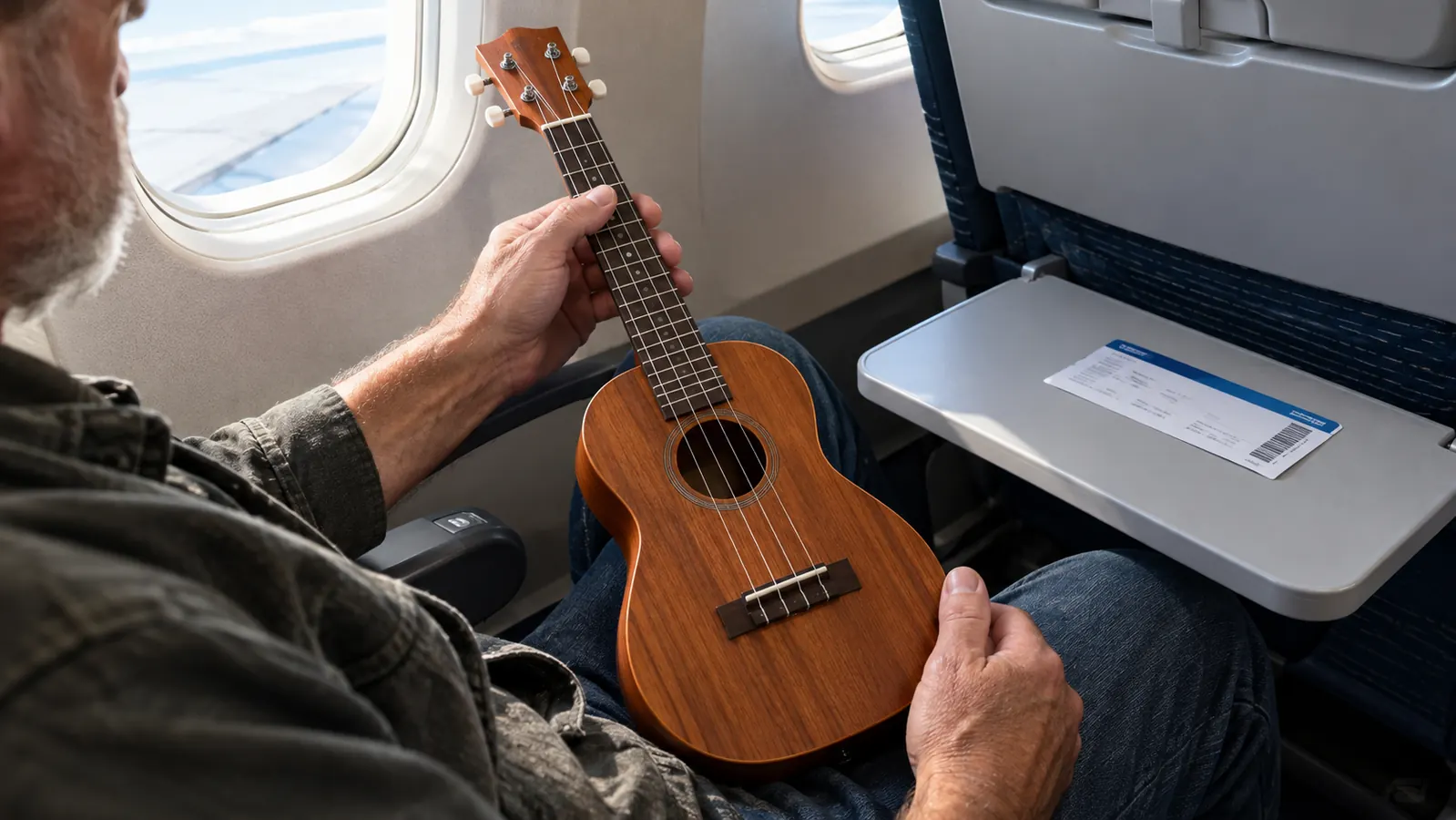
The first trip was a red-eye out of San Francisco. I wrapped the gig bag in a light jacket and put it in the overhead bin, body sideways so the strings pointed toward the window. The second trip was ten days on Oahu in June, where it lived on the family lanai and got played every evening. The third was a long weekend in Santa Cruz with the 4Runner, where it rode behind the rear seat in a duffel with a sleeping bag on top. By the end of that summer it had been through SFO, HNL, and three different rental cars, and it had not needed anything beyond a tune-up.
I have left it in a warm car for an afternoon, dropped it once on a hotel carpet, and watched it bounce around in the back of the 4Runner when a bag shifted on a dirt road. The drop happened at the end of a long travel day, and I honestly expected a crack. It needed one small tuning adjustment and nothing else. That is the kind of abuse I would not have trusted a more expensive instrument to take.
Lani has claimed it for whole afternoons, which is the highest compliment she pays any instrument. She usually plays a few songs after dinner, and she has told me more than once that the concert size feels right in her lap. This has become the household instrument, not just my travel instrument. That is the real reason I trust it: it gets played every day by someone, and it has never let either of us down.
What the Donner Concert Ukulele Gets Right
Start with size. A concert ukulele sits between the smaller soprano and the larger tenor, and for my hands it is the sweet spot. The fretboard is wide enough that my fingers do not crowd together, but the body is still small enough that I can play it sitting in an airplane seat without elbowing the person next to me. I have done exactly that on a red-eye to Honolulu, and the passenger beside me asked where to buy one before we landed.
The tone is warm and full for an instrument this size. The mahogany body gives it a mellow voice that suits both strumming and fingerpicking. It is not a hand-built Hawaiian koa instrument, and it does not pretend to be. But when I play it on the lanai at sunset, it sounds like a ukulele should sound: bright enough to be happy, soft enough not to annoy the neighbors.
The fretwork is clean. I have played budget instruments where the fret ends feel like tiny saw blades, and the Donner does not have that problem. The action is low enough that barre chords are comfortable, which matters to me because my hands are not as forgiving as they were when I was mixing monitors in my twenties.
The geared tuners have held their position through Honolulu humidity, dry hotel air, and the temperature swings of a car parked in the sun. I check tuning every time I pick it up, but it rarely needs more than a nudge on one or two strings. After the drop, it came back to pitch after a quick pass with a clip-on tuner, and it has stayed there.
Intonation is better than I expected on a ukulele in this class. The open chords ring clean, and the notes up past the seventh fret stay true enough that I do not feel like I am fighting the instrument when I move beyond the basic shapes. That is the difference between an instrument you play for ten minutes and one you play for an hour.
I have played a friend's Kala concert from time to time, and the Donner is not embarrassed next to it. The Kala has a slightly rounder low end, but the Donner is brighter and more present when you are strumming on a beach with wind noise. For what I do, that brightness is actually an advantage.
The laminate construction is another travel-friendly choice. Laminate tops do not crack as easily as solid wood when humidity changes fast, and they do not need the careful seasoning that a solid koa instrument demands. That matters when you are moving between a humid island and a dry airplane cabin. The tradeoff is that it will never open up the way a solid top does, but for a travel instrument, I will take that trade every time.
How It Holds Up Over Time
The real test for any travel instrument is not how it sounds on day one. It is how it sounds after month twelve, after the temperature swings, the baggage carousel near misses, and the casual bumps that happen when you live out of a backpack. The Donner has held its setup remarkably well. The neck has not warped, the tuning pegs still turn smoothly, and the intonation stays true up the fretboard.
The stock strings are the weakest link. They are playable, but they went dull faster than I expected. I replaced them with a set of fluorocarbon strings about three months in, after roughly ninety hours of play. That is a fifteen minute job, and it made a noticeable difference in sustain and clarity. If you buy this ukulele, budget that small task into your plans from day one.
The gig bag is fine for what it is: a soft shell with a handle and a shoulder strap. It protects against dust and light bumps, and it fits in overhead bins. It is not a hard case, and I would not check it as luggage. If you plan to fly often, a lightweight hard case is worth considering, but for carry-on travel the included bag has been enough for me.
The finish has held up better than I expected. After six round trips and one drop, the Donner has picked up a couple of small scuffs on the back, but they are invisible unless you look for them, and no cracks have appeared despite the temperature swings between Honolulu and the California coast. I have seen more expensive instruments develop finish cracks from less.
One thing that did not happen: the neck did not shift. I have owned travel instruments that developed a slight bow after a year, especially when they spent time in a hot car. The Donner's neck is still straight, and the action has not changed since the day I bought it. That is the kind of consistency I did not expect from a ukulele at this level.
After the string change, I also added a simple fabric strap. The Donner has a strap button on the bottom, which is not always the case on budget instruments. Now I can play standing up at a campfire without gripping the neck, and that small feature makes a bigger difference than you might think.
One thing I do not do is expose it to extreme cold. I learned that lesson decades ago with a guitar in a van. On trips where the outside temperature drops below freezing, I bring the ukulele into the hotel room and let it warm up slowly before I open the case. That is common sense, not a knock on the Donner, and it has helped everything I own survive.
During a long session on the lanai, I have had one string go slightly flat after twenty minutes of hard strumming. That is normal for a new ukulele with stock strings, but it stopped happening after the strings were broken in. By the time I changed strings, tuning stability was rock solid for an entire evening.
What I Liked
- Carry-on friendly 23 inch concert size that fits in overhead bins and backpacks
- Warm, full tone from the mahogany body that suits strumming and fingerpicking
- Clean fretwork and low action that stay comfortable for older hands
- Holds its setup through temperature swings, drops, and casual travel abuse
- Genuinely playable out of the box, with room to improve with better strings
Where It Falls Short
- Stock strings go dull faster than I would like
- Included gig bag is soft shell only, not for checked luggage
- Not the projection or tonal depth of a high-end instrument
Six round trips to Hawaii, one drop on a hotel carpet, and the only repair the Donner ever needed was a twist of a tuning peg.

Who This Is For
The Donner concert ukulele is for anyone who wants a real instrument, not a wall decoration. It is for the person who wants to play on a beach, in a hotel room, or on a friend's porch without worrying about a precious instrument getting scratched. It is for beginners who want something that stays in tune while they learn, and for experienced players who want a travel beater that still sounds good enough to enjoy.
It is also for people who fly with their music. The concert size fits in carry-on luggage, the soft bag is accepted by every airline I have flown, and the whole thing weighs little enough that you will not notice it in your pack. If you have ever left an instrument at home because it was too much trouble to bring, this ukulele removes that excuse. I know, because I used to be that person.
The concert body is also a smart choice if you have tried a soprano and found it too cramped. The extra inch or so of scale length gives you a little more room between frets, and the slightly larger body pushes a touch more air. For a first instrument, that little bit of extra comfort can be the difference between playing for a week and playing for years.
If you are buying for a teenager, this is a better choice than the toy ukuleles on the shelf. It is a real instrument with real tuning pegs, and it will not make them fight to get a clean sound. The concert size is forgiving for smaller hands, and you will not panic when it gets a scratch.
Who Should Skip It
If you are a professional player looking for a stage-grade instrument with a rich, complex voice, this is not that ukulele. The Donner is a very good budget instrument, but it does not have the projection or the tonal depth of a hand-built koa instrument. You will hear the difference in a quiet room, and so will your audience.
If you want a hard case for checked luggage, this is not the one for you, and the included soft bag will not survive the baggage hold. If you prefer a tenor scale for its larger fret spacing, you will find the concert body a little cramped. And if you are the kind of player who will never change the stock strings, know that the Donner sounds its best after a simple upgrade. None of these are dealbreakers for me, but they are worth knowing before you buy.
This is also not the instrument to choose if you need a quiet, intimate voice for recording. The Donner projects well for its size, but it does not have the complexity you would want in a studio. For practicing, travel, and campfires, it is more than enough. For a recording session, reach for something with a little more headroom.
If you already have a ukulele you love, skip this one. It is not a sideways upgrade. It is a different tool for a different job, and you will not gain much by owning both unless you need the carry-on-friendly size.
Pack it once, play it everywhere
The Donner concert ukulele has earned its spot in my carry-on for every trip since I bought it. If you want a travel instrument that sounds good and takes a bump, check today's price on Amazon.
Amazon Check Today's Price on Amazon →