
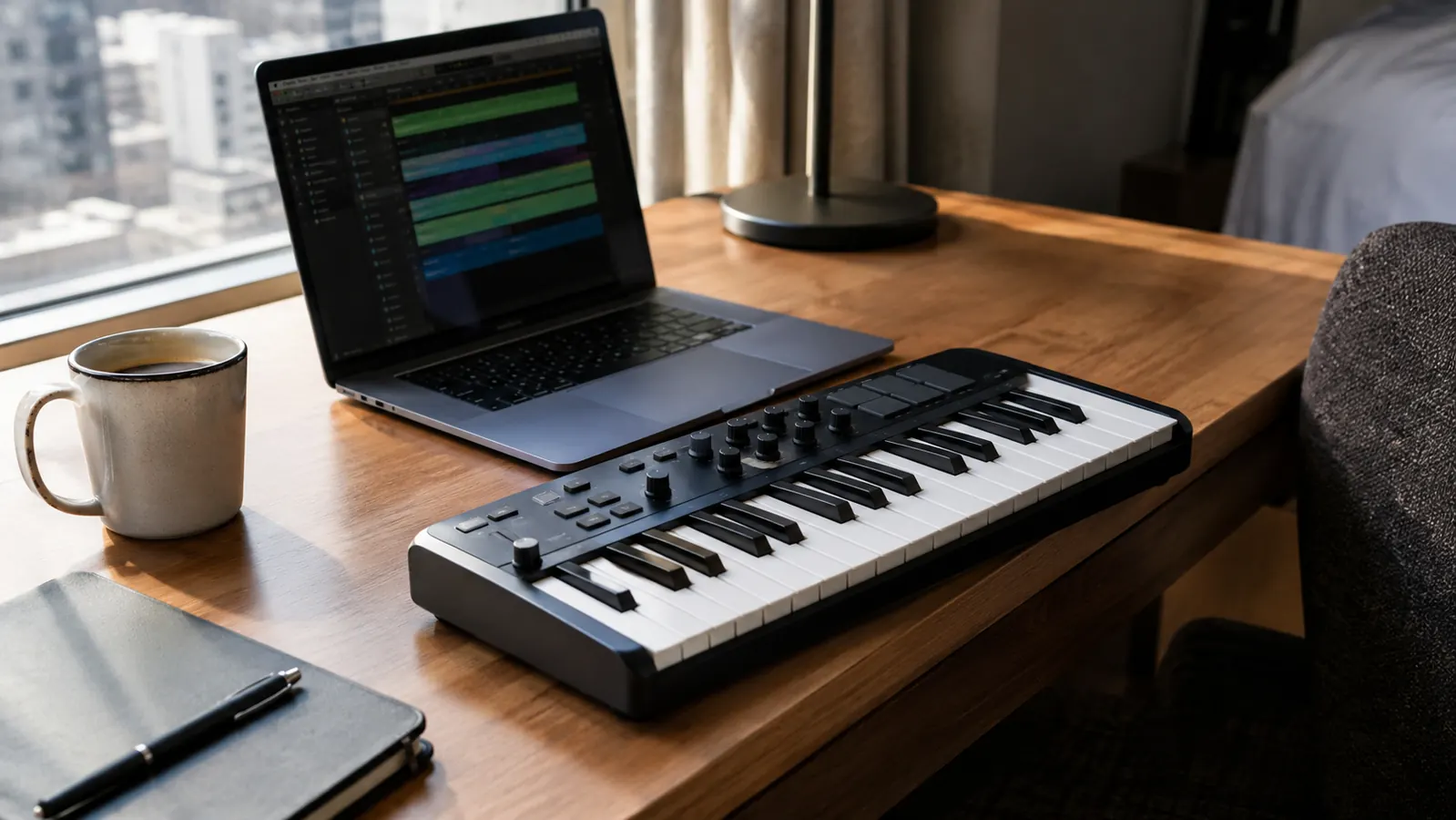
I've spent thirty years behind mixing consoles, and the one thing I learned is that gear you don't bring with you is gear you don't have. So when I retired from live sound and started flying to Oahu a few times a year to see family, I made a rule: everything I pack has to fit in one carry-on backpack. That rule is what led me to the Akai Professional MPK Mini IV, a 25-key USB-C MIDI keyboard controller that has now survived six flights, two rental cars, and a beach campsite on the California coast.
I'm Wes Kaneshiro, 52, a weekend acoustic player who spent decades running sound for other people's bands. I don't need a studio in a hotel room. I need something that fits in my bag, powers on without a fuss, and lets me sketch an idea before it evaporates. The Akai MPK Mini IV has become that something.
The Quick Verdict
The Akai MPK Mini IV is the rare travel instrument that disappears into a carry-on and still feels like a real instrument when you pull it out. It is not a toy, but it is also not a full-size workstation. For a weekend musician who wants to capture ideas on the road, it is the best compact keyboard I have used.
Amazon Check Today's Price →A 25-key keyboard that actually fits your carry-on
The Akai MPK Mini IV packs 25 velocity-sensitive keys, eight pads, and eight knobs into a frame that slips into a backpack pocket. I have carried mine through six flights without checking a bag.
Amazon Check Today's Price on Amazon →How I've Used It
My test routine is not a lab test. It is a real travel routine. I fly from San Luis Obispo to Honolulu a few times a year, and I take the 4Runner up and down the California coast for weekend trips. The MPK Mini IV comes with me on both kinds of trips.
On the plane, it lives in the main compartment of my carry-on backpack, wrapped in a t-shirt. In the hotel, it sits on the desk next to my laptop. At the beach campsite, it rode in the passenger footwell of the 4Runner and got sand on it once. I have used it to sketch chord progressions, to practice finger placement on the mini keys, and to control drum sounds in my DAW when I wanted to lay down a beat without dragging out a full controller.
The key question for me was never whether it sounds good. A MIDI controller does not make sound on its own. The question was whether it feels good enough to make me want to play it, and whether it survives the kind of abuse a travel bag dishes out. After a year, the answer to both is yes.
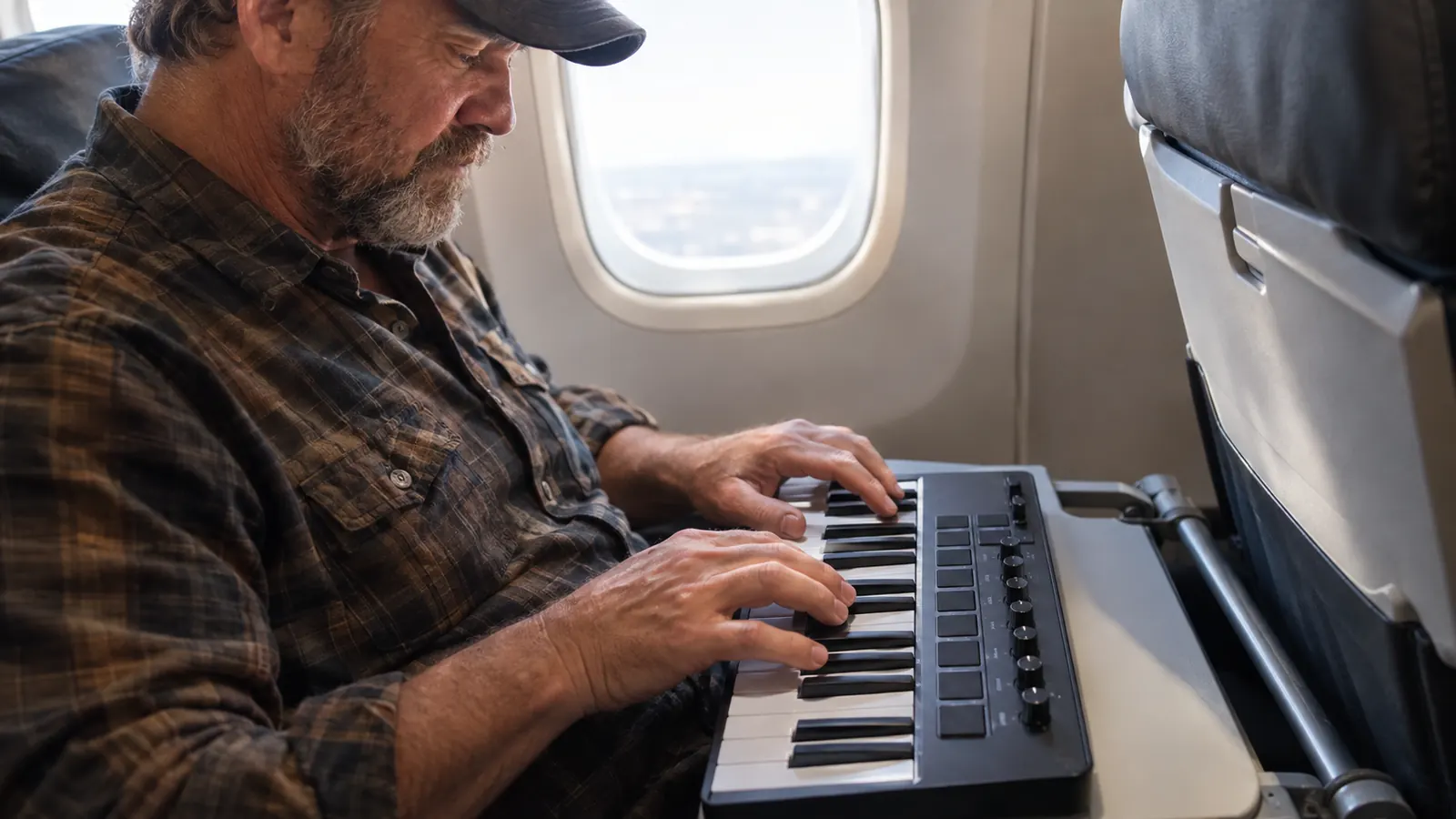
The first real test came on a flight to Honolulu in March. I had a window seat, and I pulled the keyboard out of my backpack after the drink service. The tray table is just barely wide enough for the MPK Mini IV, and I spent about forty minutes sketching a verse progression that later became a full song. Nobody around me seemed to mind, and the keys are quiet enough that I did not feel like I was bothering anyone. That was the moment I stopped thinking of it as a travel compromise and started thinking of it as my main sketchpad.
What the Akai MPK Mini IV Actually Is
The Akai Professional MPK Mini IV is a 25-key MIDI keyboard controller. That means it does not produce sound by itself. It sends note and control data to a computer, phone, or tablet over USB-C, and the software on that device produces the sound. If you already have a laptop with a free DAW like GarageBand or a phone with a synth app, the MPK Mini IV turns that device into a portable instrument.
The fourth generation of this little keyboard kept the layout that made the MPK Mini line popular: 25 mini keys, eight backlit drum pads, and eight assignable knobs. What changed under the hood is the connection. The IV uses USB-C, which means it works with modern laptops, tablets, and phones without a dongle. It is also bus-powered, so there is no wall wart and no battery to charge. If your device has a USB-C port and power to spare, the keyboard just works.
That last point matters more than you might think. I have owned portable keyboards that needed their own power supply, and they always ended up left behind because they were one more thing to charge. The MPK Mini IV does not have that failure mode. It draws power from the same cable that carries the data.
The whole unit is about 12.5 inches wide and weighs just over a pound and a half. I measured it against the main compartment of my backpack before I bought it, and it fits with room to spare next to my laptop. The depth is the part that surprised me. It is shallow enough that it slides into the padded laptop sleeve of my bag, which means I do not have to choose between carrying the keyboard and carrying a change of clothes.
How It Feels to Play
The mini keys are the thing most people worry about, and I get it. I grew up on a full-size acoustic piano, and mini keys can feel like a compromise. The Akai MPK Mini IV keys are not the best mini keys I have ever touched, but they are better than the price suggests. They have a light, snappy action with enough resistance that you can play expressively, and the velocity response is consistent across all 25 keys. I have played cheaper controllers where the velocity curve was all over the place, and this is not that.
The eight pads are the surprise. I expected them to be a gimmick, but they are genuinely playable for finger drumming. The sensitivity is adjustable, and after a few minutes of tweaking I got them to respond the way I wanted. The eight knobs are smooth and map easily to whatever software you are using. For a device this small, the control surface is remarkably complete.
The built-in arpeggiator is a feature I did not expect to use, and now I use it constantly. It turns a simple chord into a moving pattern, which is perfect for sketching song ideas in a hotel room at midnight. It is the kind of feature that makes the MPK Mini IV feel like more than a travel compromise.
I will be honest about the learning curve. The first time I tried to play a two-handed part, my left hand kept drifting onto keys that were not where I expected them to be. It took about two weeks of ten-minute practice sessions before my hands stopped reaching for full-size spacing. Now I can play a simple chord melody without looking down, and that is more than I expected from a keyboard this small. The velocity curve took a little longer. Out of the box, my soft playing registered a bit too quiet, so I adjusted the global velocity curve in the software and saved it to the keyboard's memory. That setting has stayed put through every flight since.
How It Holds Up on the Road
Durability was my biggest worry. A keyboard with exposed keys and knobs seems like it would not survive a week in a backpack. After a year, mine has a few scuffs on the corners and one knob that is slightly looser than the others, but everything still works. The keys still respond, the pads still trigger, and the USB-C connection is still solid.
The one thing I would change is the lack of a hard case. The MPK Mini IV does not come with one, and I have seen enough gear in my years to know that a soft t-shirt wrap is not a long-term solution. I bought a cheap padded case for mine, and I would recommend anyone who travels with it do the same. That is not a knock on the keyboard itself. It is just the reality of traveling with gear.
Battery life is a non-issue because there is no battery. It runs off the host device's power, which means you never have to remember to charge it. The tradeoff is that it will drain your laptop or phone a little faster, but I have not noticed a meaningful difference in my own use.
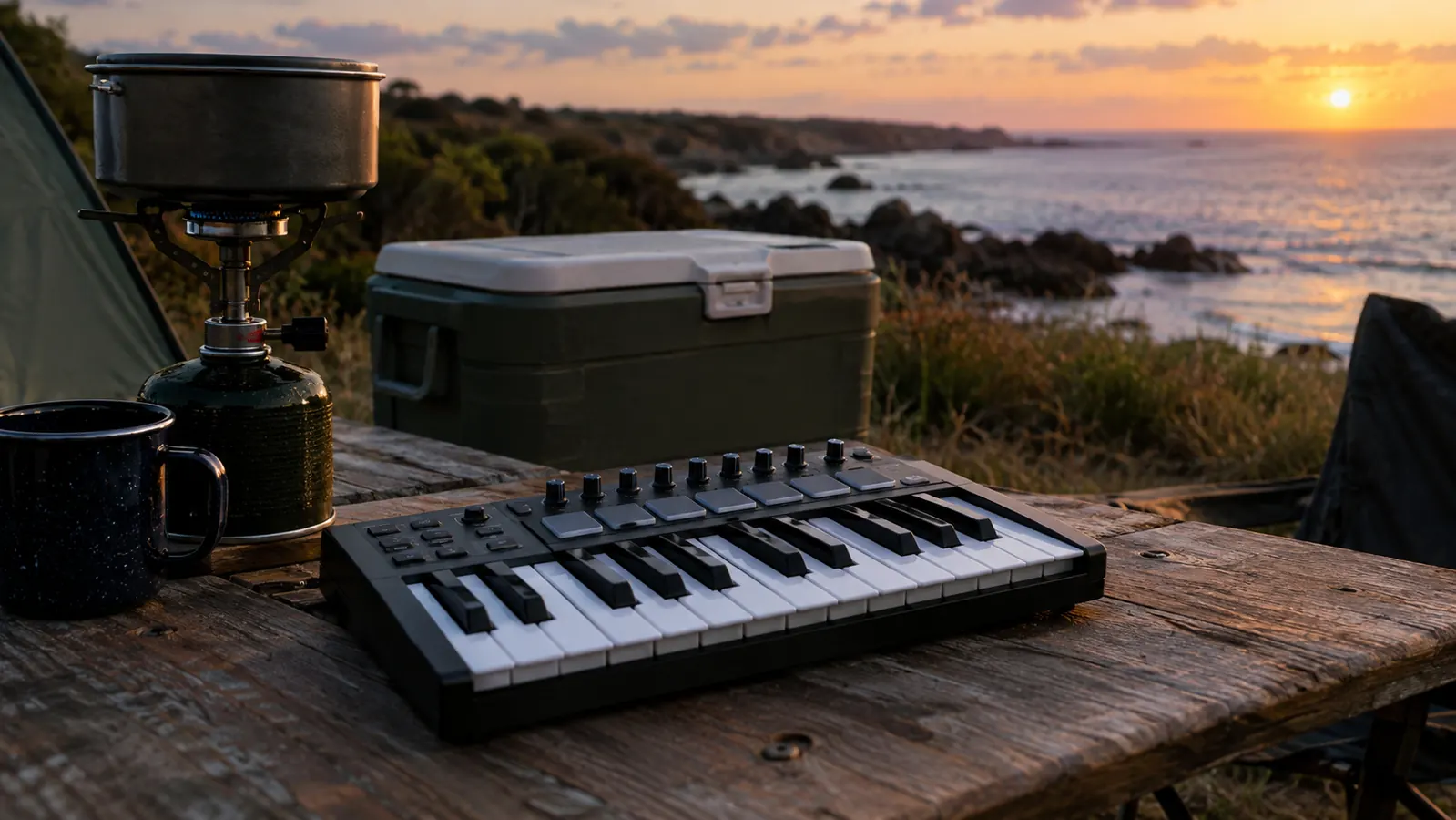
The sand incident happened at the campsite near Morro Bay in May. I left the keyboard on the picnic table while I went to start the camp stove, and a gust of wind blew a fine layer of sand across the keys and pads. I brushed it off, tapped the pads a few times to clear the contacts, and it kept working for the rest of the weekend. I would not recommend that as a test, but it tells you something about how the build holds up to real life. The scuffs on the corners came from the same trip, when the keyboard slid across the floor of the 4Runner and hit the door sill. Nothing broke, and nothing stopped working.
What I Liked
- Genuinely portable: fits in a carry-on backpack pocket
- USB-C connection works with laptops, tablets, and phones
- Bus-powered, so no battery to charge and no wall wart
- Pads and knobs are more playable than the price suggests
- Built-in arpeggiator is genuinely useful for sketching ideas
Where It Falls Short
- Mini keys take getting used to if you play full-size keys
- No hard case included, and you will want one for travel
- No built-in speaker or sound engine, so it needs a host device
- One knob on my unit loosened slightly after a year
After a year, the answer to both questions is yes: it feels good enough to make me want to play it, and it survives the abuse a travel bag dishes out.
One small thing I would add after all these months: the Akai MPK Mini IV is the rare piece of gear I have never once had to troubleshoot on the road. I plug it in, the laptop sees it, and I play. That reliability matters more than any spec when you are sitting in a hotel room with forty minutes before dinner and an idea you do not want to lose.
Who This Is For
The Akai MPK Mini IV is for the weekend musician who wants to keep creating while they travel. If you are someone who already has a laptop or phone and wants a way to sketch ideas, practice finger placement, or lay down a beat without hauling a full-size keyboard, this is the device. It is also a great first MIDI controller for someone who is just getting into music production and does not want to spend a fortune on something they might not use.
It is especially good for the traveler who is tired of leaving their music at home. I have written more song ideas in hotel rooms in the last year than I did in the two years before I bought it, and that is entirely because the MPK Mini IV is small enough to come with me.
I would also point a gigging musician toward it as a backup. I have seen too many tours fall apart because a keyboard died in transit and there was no spare within reach. The MPK Mini IV is cheap enough and small enough that throwing one in a flight case next to the main rig is not a hard decision. It will not replace a full-size stage keyboard, but it will absolutely save a show in a pinch.
Who Should Skip It
If you are a pianist who needs a full-size keyboard with weighted keys, the MPK Mini IV will frustrate you. The mini keys are a compromise, and no amount of clever engineering changes that. If you want a standalone instrument that makes sound without a computer, this is also not it. It is a controller, not a synth.
I would also tell a beginner to think carefully about whether they want to learn on mini keys. If your goal is to play piano properly, start with a full-size keyboard. If your goal is to make music on a laptop, the MPK Mini IV is a fine place to start.
And if you are the kind of traveler who only packs the bare minimum, be honest with yourself about whether you will actually pull a keyboard out in a hotel room. The MPK Mini IV is small, but it is still one more thing in the bag. For me, the song ideas I capture on the road are worth the space. For someone who never touches music at home, it would just be dead weight.
The keyboard that comes with you
Six flights, two rental cars, and a beach campsite later, the Akai MPK Mini IV is still the first thing I pack. If you are tired of leaving your music at home, this is the one to try.
Amazon Check Today's Price on Amazon →