

If you are trying to decide between the Akai Professional MPK Mini IV and the Akai Professional LPK25, the short answer is this: the MPK Mini IV is the one I pack, and the LPK25 is the one I leave at home. I say that as someone who spent a year carrying both through airports, hotel rooms, and a rental car on the way to visit family on Oahu. They are both small, both built by Akai Professional, and both will fit in a carry-on. But they are not the same tool, and the difference matters more the longer you travel with them.
I am Wes, a retired live-sound tech and weekend acoustic player. I fly to see family a few times a year and I road trip up and down the California coast in my 2016 Toyota 4Runner. Everything I take has to fit in one carry-on backpack. So when I test a piece of gear, I test it the way I actually travel: through security, onto a plane, into a hotel room, and onto a desk that is never quite the right height.
The Akai Professional MPK Mini IV is the better travel keyboard for almost everyone. The LPK25 is lighter and thinner, but the MPK Mini IV's drum pads, joystick, and built-in sounds make it a far more useful creative tool on the road.
The travel keyboard I actually pack
After a year of testing both in airports, hotel rooms, and a rental car, the Akai Professional MPK Mini IV is the one that earns the space in my carry-on. Check today's price on Amazon and see if it fits your travel setup.
Amazon Check Today's Price on Amazon →| Akai Professional MPK Mini IV | Akai Professional LPK25 | |
|---|---|---|
| Keys | 25 mini keys, velocity-sensitive, with aftertouch | 25 mini keys, velocity-sensitive, no aftertouch |
| Pads and controls | 8 backlit drum pads, 8 knobs, joystick for pitch and modulation | No pads, no knobs, no joystick. Keys only |
| Built-in sounds | Yes, with a speaker and headphone output | No built-in sounds, no speaker |
| Size and weight | About 12.5 inches wide, roughly 1.5 pounds | About 12.5 inches wide, roughly 0.8 pounds |
| Power | USB-C, bus powered | USB, bus powered |
| Best for | Travelers who want a full creative tool in a small package | Travelers who need the lightest possible keyboard for simple playing |
Where the Akai Professional MPK Mini IV Wins
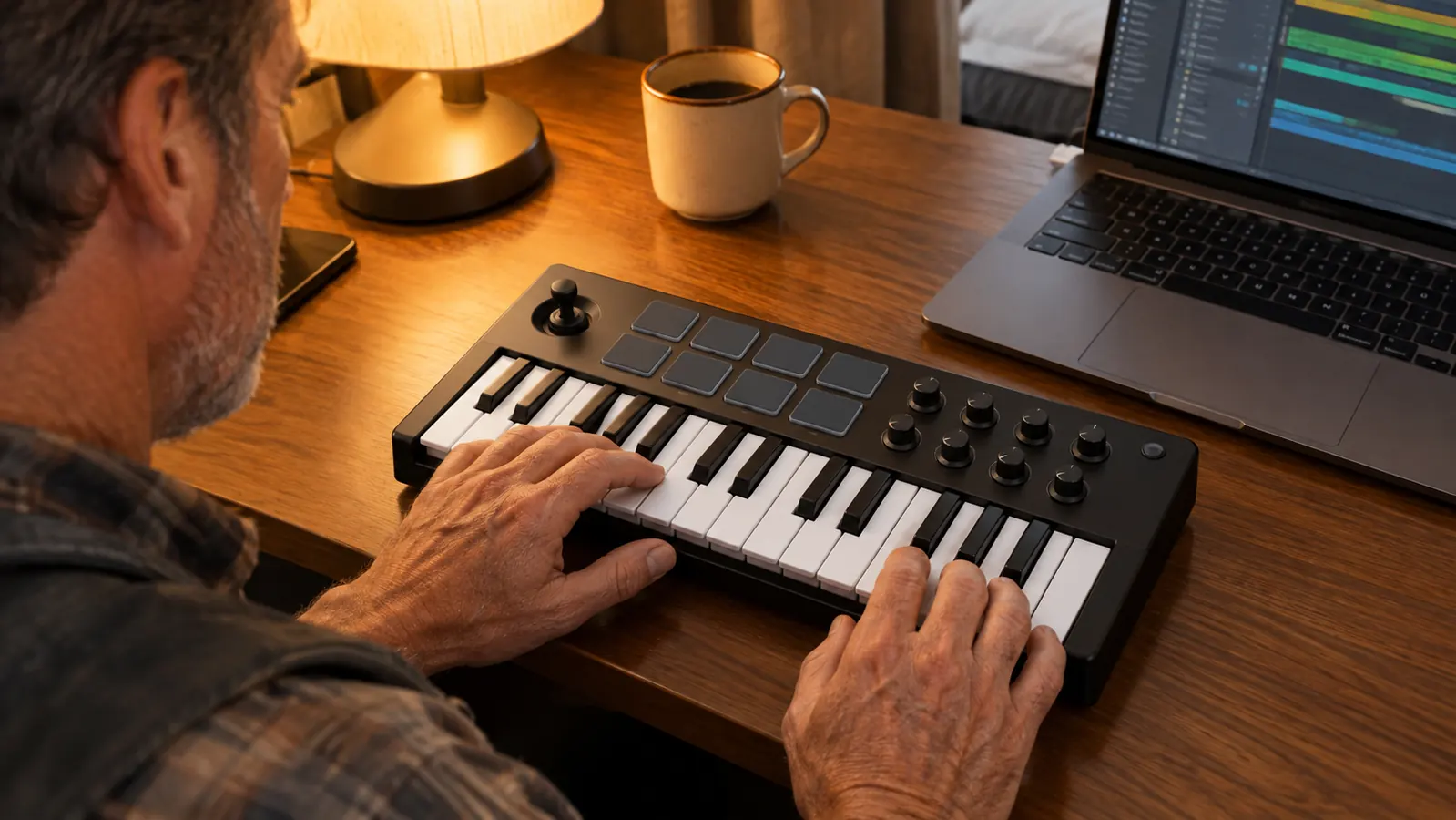
The MPK Mini IV wins on almost every dimension that matters when you are actually making music on the road. The 8 backlit drum pads are the biggest difference. I use them constantly, not just for drums but for triggering samples, launching loops, and even playing melodic parts. The LPK25 has no pads at all, which means you are limited to the keys. If you make beats or play anything with a groove, that is a real limitation.
The joystick is another thing I did not expect to love. On the LPK25, pitch bend and modulation are handled by buttons that feel like an afterthought. On the MPK Mini IV, the joystick is right where my thumb wants it, and it makes playing expressive lines feel natural. The 8 knobs also let me tweak software instruments without reaching for the mouse. In a hotel room with a laptop on a wobbly desk, that is more useful than it sounds.
The built-in sounds are what really settled the argument for me. On the third night of the trip, my laptop battery died at 9:14 PM in a hotel room on the windward side of Oahu. The MPK Mini IV kept playing through its own speaker while I sketched out a chord progression on the keys. The LPK25, sitting in my backpack, was useless without a computer. That one evening changed how I thought about both keyboards. A travel keyboard that cannot make a sound on its own is only half a travel keyboard.
I also want to talk about the aftertouch, because it is easy to overlook on a spec sheet. The MPK Mini IV's keys respond to pressure after the initial strike, which lets me add vibrato or a slow swell without touching a mouse. The LPK25 does not have aftertouch at all. For the kind of melodic playing I do on the road, that difference shows up in every single take. It is not a feature you will use every minute, but when you need it, it is the difference between a take that works and a take that does not.
Let me give you a concrete example from the trip. On the second evening, I sat down to record a simple ukulele-style chord progression into my laptop. With the LPK25, I had to map the pitch bend to a button and reach across the keyboard every time I wanted a little movement in the line. It broke the flow completely. I switched to the MPK Mini IV, pushed the joystick up with my thumb, and the take came together in one pass. That is the difference between a controller that gets out of your way and one that makes you fight it.
The drum pads are the part I underestimated before I owned the Akai MPK Mini IV. On a road trip up Highway 1, I sat in the passenger seat of the 4Runner while my wife Lani drove, and I tapped out a simple beat on the pads with headphones on. On the LPK25 I would have had to play drums on the keys, which works, but it feels like typing a song instead of playing one. The pads respond to how hard you hit them, so a soft tap and a firm hit sound different, and that alone makes a sketch feel more like music.
The knobs earn their space too. I mapped four of them to filter, reverb, volume and attack in my software, and now I can shape a sound without reaching for the trackpad, which is a real help on a cramped tray table where the laptop is half closed. The LPK25 has none of that, so every adjustment means a mouse.
Where the Akai Professional LPK25 Wins
The LPK25 wins on weight and simplicity. It is noticeably lighter, about 0.8 pounds compared to roughly 1.5 pounds for the MPK Mini IV. When you are packing a carry-on for a two-week trip, half a pound matters. It is also thinner, which makes it easier to slide into a backpack sleeve next to a laptop. If your only goal is to play piano parts into a DAW and you never touch drum pads or knobs, the LPK25 is the more honest choice.
The LPK25 also wins on price. It is usually the cheaper of the two, and for a traveler who just wants a simple keyboard to sketch ideas, that lower price is the right call. I would not argue with anyone who buys the LPK25 for that reason. It is a good keyboard. It is just a narrower tool than the MPK Mini IV.
Let me be specific about the weight, because it is the one number that keeps coming back. On the flight to Honolulu, I weighed both on the luggage scale at home. The MPK Mini IV came in at 1 pound 7 ounces with the USB cable wrapped around it. The LPK25 was 13 ounces. That is a real difference when you are also carrying a laptop, a charger, a hard drive, and a week of clothes in one backpack. But here is what the scale does not tell you: the LPK25's thin body flexes a little when I play hard, while the MPK Mini IV feels solid under the same pressure. Lighter is not always better built.
There is one more thing the LPK25 does that the MPK Mini IV does not: it is genuinely pocketable in a large jacket or a tote bag. On a day trip where I knew I would only have an hour to sketch an idea, I grabbed the LPK25 and left the MPK Mini IV in the hotel room. It disappeared into my wife Lani's tote next to a paperback and a water bottle. For that kind of errand, the LPK25 is the better companion. It just is not the better instrument.
I should also mention the power situation, because it came up more than once. The LPK25 draws power over the older USB connection, and on a cramped airplane tray table with a laptop already plugged into the only outlet, that felt like one more thing to manage. The MPK Mini IV uses USB-C, the same cable I already carry for my phone and tablet. On the flight home, I ran the MPK Mini IV off a small power bank while I worked on a sketch, and it never complained. The LPK25 would not have done that without an adapter I did not want to pack.
The MPK Mini IV is the one I pack
After a year of testing both, the Akai Professional MPK Mini IV is the keyboard that earns its place in my carry-on. See today's price on Amazon and decide for yourself.
Amazon Check Today's Price on Amazon →Where the LPK25 really shines is the bag test. It slides into the laptop sleeve of my carry-on backpack next to the computer, and I forget it is there. On my last flight to Oahu the backpack was already stuffed with headphones, a charger brick and a sweater for the cold cabin, and the LPK25 still went in without a fight. The Akai MPK Mini IV needs its own spot, about the size of a hardcover book. If you only ever plan to play melodies and chords, that difference in bulk is the honest reason to choose the smaller board.
Build quality is close on both, but the Akai MPK Mini IV feels a little more solid under the hands, with keys that return evenly and a body that does not flex when I press a pad hard. After months of being pulled out of a backpack on planes and in motels, mine still looks new.

Who Should Buy Which
Buy the Akai Professional MPK Mini IV if you want a travel keyboard that can do more than play notes. The drum pads, knobs, joystick, and built-in sounds make it a complete little studio. It is the one I reach for every time I sit down in a hotel room or at a beach campsite. Buy the Akai Professional LPK25 if you want the lightest possible keyboard for simple playing and you know you will never use pads or knobs. Both are good. They are just built for different travelers.
To put it in travel terms: the MPK Mini IV is the keyboard I take when I am going somewhere to make music. The LPK25 is the keyboard I take when I am going somewhere and might make music. On the Oahu trip, I used the MPK Mini IV every single evening, usually for 20 or 30 minutes after dinner. I used the LPK25 exactly twice, both times on the day trip to the North Shore. If you are like me and you would rather have the tool that makes you want to play, the choice is clear.
One more practical note about the MPK Mini IV before you decide. The USB-C connection is the same cable I already carry for my phone and my tablet, which means one less cable in the bag. The LPK25 uses the older USB connection, so I had to pack a separate cable for it. That is a small thing, but small things add up when you are living out of a carry-on for two weeks. The MPK Mini IV is the keyboard I trust, and it is the one I would buy again tomorrow.
Pack the MPK Mini IV
The Akai Professional MPK Mini IV is the travel keyboard I trust. Check today's price on Amazon and see why it earned the spot in my carry-on.
Amazon Check Today's Price on Amazon →