I spent thirty years behind mixing consoles, and I still catch myself walking into a hotel room and doing a quick mental sound check. Where are the hard surfaces? How far is the bed from the TV? Is there a corner I can load? My wife Lani used to roll her eyes at it. Now she just hands me the speaker and says, "Make it sound like you." The problem with hotel rooms is not that they are quiet. It is that they are acoustically dead or randomly reflective, and most people just plop the speaker down on the bed and accept whatever comes out.
This guide is the method I use when I travel, whether I am flying to Oahu to see family or driving up the California coast in my 2016 4Runner. It works with any decent portable speaker, but I will be specific about the JBL Flip 6 because it is the one I have tested the most. It is small enough to live in my carry-on backpack, tough enough to survive the trip, and loud enough to do the job without pretending to be a PA system. It fits in the water bottle pocket of my backpack, weighs about 1.1 pounds, and runs around twelve hours on a charge. Those numbers matter more on the road than any spec sheet.
Start with a speaker that can actually fill the room
The JBL Flip 6 is the speaker I pack for every trip. It fits in a carry-on, survives the beach, and sounds clear at hotel-room volume. Check today's price on Amazon and see if it fits your bag.
Amazon Check Today's Price on Amazon →Step 1: Place the speaker where the room can hear it
The single biggest mistake I hear in hotel rooms is a speaker sitting on the floor next to the bed, pointed at the carpet. Carpets eat high frequencies. The sound gets mushy, the vocals disappear, and the natural reaction is to turn the volume up, which makes the mud worse.
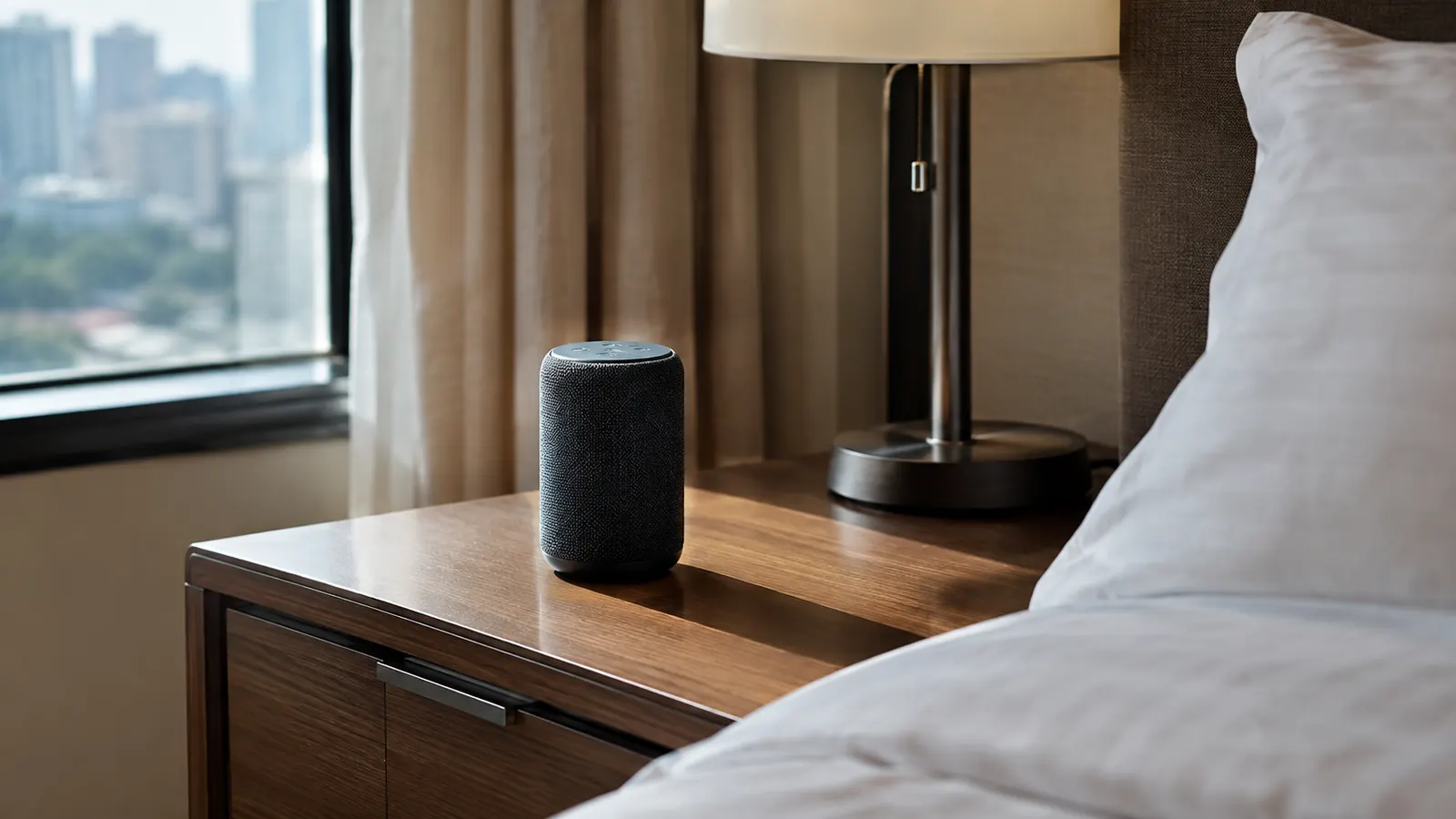
Get the speaker up off the floor and onto a hard surface. A desk, a dresser, a nightstand, even the closed lid of a suitcase on the luggage rack. The JBL Flip 6 has a passive radiator on each end, and it throws sound in a wide pattern, so it does not need to be pointed at you like a flashlight. It needs to be out in the open, not buried in a duffel or wedged between pillows.
On a recent trip to Oahu, I started with the speaker on the floor next to the sliding glass door, because that was the first flat surface I saw. The bass was boomy and the vocals were buried. I moved it to the nightstand, about three feet off the floor, and the difference was immediate. That is the whole method in one anecdote: move the speaker until it sounds like music, not noise.
If you are near a pool or a balcony, the same rule applies. Concrete reflects, so you want the speaker up on a table or a chair, pointed at the people, not at the ground. A speaker on the floor at a pool party sounds muffled before anyone has even turned it up.
Step 2: Aim for ear level, not ceiling level
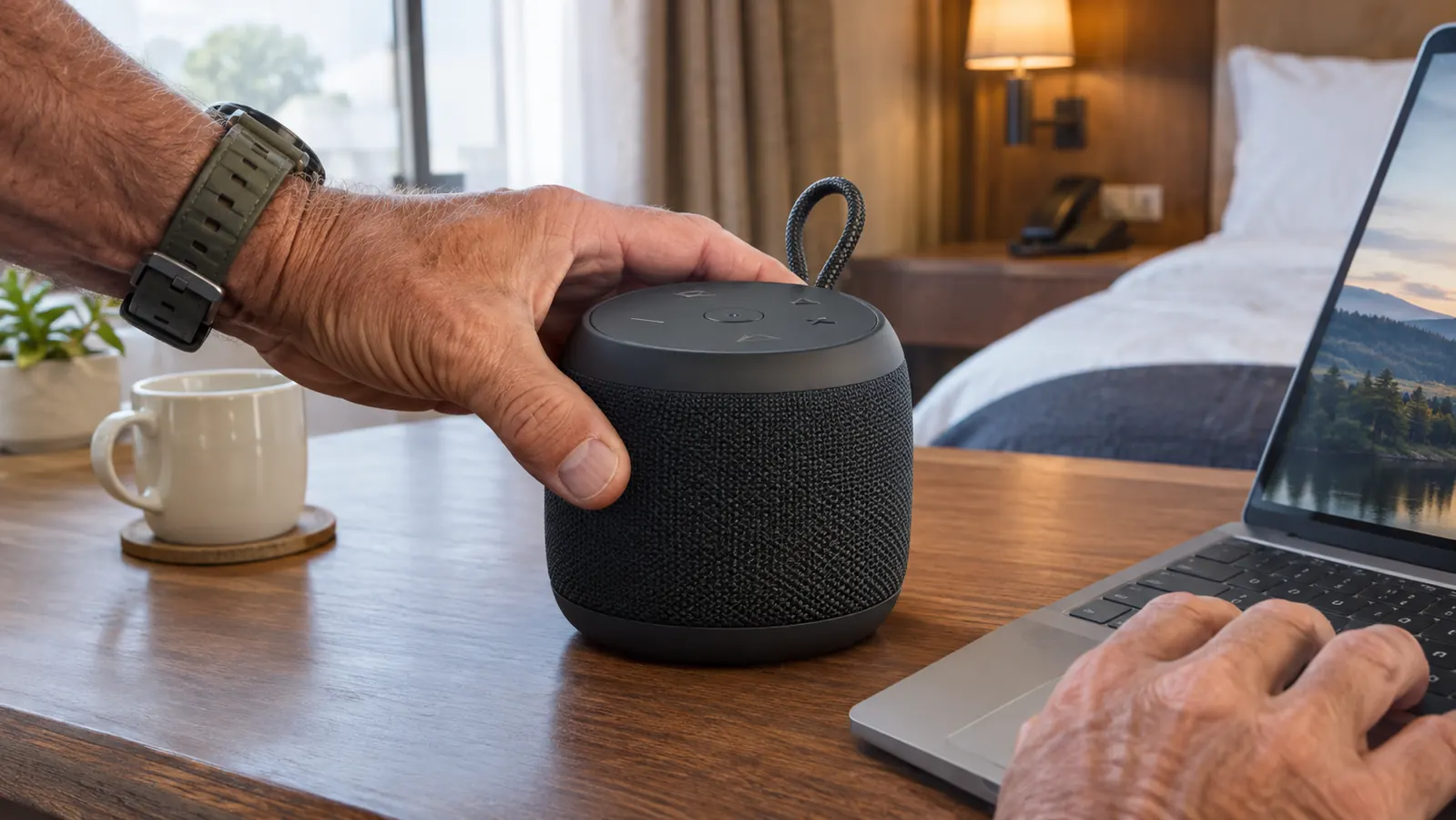
Here is the part that surprises people who have only ever used a phone speaker. You do not want the speaker blasting at the ceiling. You want it roughly at ear level when you are sitting on the bed or in the desk chair. That is where your ears actually are, and that is where the speaker sounds its best.
A nightstand is usually about right. A dresser is often a little high, but it works if the speaker is angled slightly down. The JBL Flip 6 has a fabric loop on one end, so you can hang it from a hook or a coat hanger if the room has one. Hanging it gets it off the furniture and into open air, which can sound even better than a shelf. When I do that, I make sure the loop is on the side that faces the room, so the drivers are not pointed at the wall.
If you are using the speaker for background music while you work, set it behind the laptop or off to one side. If you are using it for a movie, set it in front of the screen, not behind it. Sound that arrives from the same direction as the picture is easier to follow, and you will not have to run the volume as high. The Flip 6 is small enough that repositioning takes two seconds, so there is no reason not to try a spot before you settle.
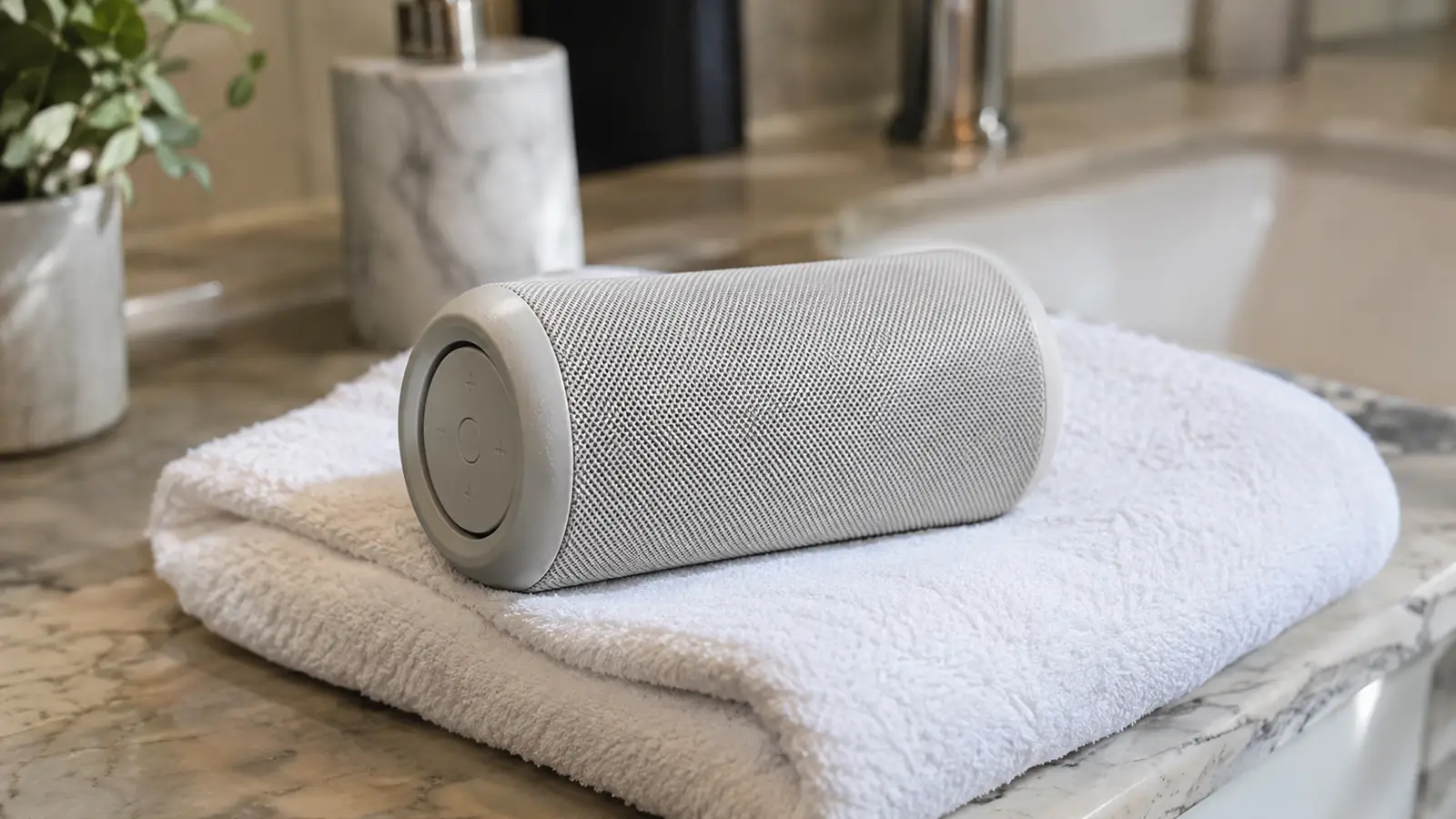
One hotel trick I use often: put the speaker in the bathroom and leave the door open. The tile reflects the high end, the towels absorb the harsh edges, and the result is a bigger, fuller sound than the same speaker on a nightstand. It is not a recommendation for every room, but it is worth testing because the bathroom is almost always a different acoustic space than the bedroom.
Step 3: Use the room's furniture as your sound system
A hotel room is basically an untreated room with a lot of reflective surfaces. That can work in your favor if you think of the furniture as part of the system. A hard desk reflects high frequencies. A padded headboard absorbs them. A glass shower door reflects them. A stack of towels absorbs them. You are not fighting the room; you are using it.
The practical version is simple. If the room sounds harsh, put a towel or a jacket under the speaker or on the surface in front of it. If the room sounds dead, move the speaker closer to a hard wall or a window. If the bass sounds boomy, pull the speaker away from the corner and give it a few inches of breathing room. I have also had good luck placing the speaker on the closed lid of the toilet, which sounds odd but gives you a solid, non-reflective platform in a small bathroom.
If the room has a corner with a hard floor, try that. A corner gives you a little natural boundary loading, which is a fancy way of saying the walls help push the low end around. It is not a substitute for a subwoofer, but it is free, and it costs you nothing to try. Just keep an eye on the bass; if it starts to boom, move the speaker a foot or two away from the corner and the problem usually fixes itself.
I have learned to check what is behind the speaker. A heavy curtain will swallow a surprising amount of detail. A glass door will bounce it around. The JBL Flip 6 is small enough that you can move it around the room in seconds, so experiment. You are not going to break anything by trying the desk instead of the nightstand. On a longer stay, I will even move the speaker once a day to match how I am using the room.
Step 4: Set the volume on the speaker, not the phone
This is the step I see everyone get wrong. They crank the phone to 100 percent and then try to fine-tune the volume with the tiny buttons on the speaker. That is backwards. The phone's volume control is the coarse adjustment. The speaker's volume control is the fine adjustment.
Set the phone to about 80 percent, then use the JBL Flip 6's own buttons to find the level that works for the room. You get much finer control, and you avoid the distortion that shows up when the phone's amplifier is pushed to its limit. The Flip 6 has a clean top end, but no small speaker sounds good when the source is clipping. I found this out the hard way in a rental car once, where the phone was at full volume and the speaker was rattling.
If the room still sounds thin after you have dialed in the volume, do not just crank it louder. First check whether the speaker is pointed at a soft surface, and then try a spot closer to a wall. The Flip 6 can get loud, but loud does not fix placement problems. It just makes them more obvious.
One more thing. If the room has a TV, and you are trying to watch a movie with the speaker, turn the TV's own speakers down or off. Otherwise you get two sound sources fighting each other, and the dialogue ends up smeared. The Flip 6 will handle the audio by itself, and it will do it more clearly than the TV's built-in speakers. The same trick works for podcasts and audiobooks, which do not need a lot of bass but do need clarity.
Step 5: Keep the battery happy for the whole trip
The JBL Flip 6 runs about twelve hours on a charge at moderate volume. That is usually enough for a full travel day, but hotel rooms are where I have learned to be a little careful. If you are going to be out all day and want music in the evening, charge the speaker while you are in the shower or at dinner.
The Flip 6 charges over USB-C, which is the same cable I already carry for my phone and my earbuds. That is a bigger deal than it sounds. I do not carry a separate charger for the speaker, and I do not have to remember a second cable. It also means I can top it off from a laptop or a power bank if I need to. USB-C is the one cable that has made everything else simpler.
One habit I have gotten into: when I check into a room, I plug the speaker in right away, even if it is half full. That way it is ready whenever I want it, and I do not have to hunt for an outlet at 11 PM. And if you are flying, remember that the battery has to go in your carry-on, not your checked bag. The Flip 6 is small enough that this has never been a problem for me, but I always keep it in my backpack anyway.
On a longer stay, I keep the speaker plugged in overnight so I never start the day with a dead battery. The Flip 6 stops charging when it is full, so leaving it on the charger is not a problem. This also means the speaker is ready for an early morning call or a quick stretch session in the room.
What Else Helps
A few small things make the whole setup easier. A short USB-C cable is lighter than the long one that came in the box, and it packs flatter. A small carabiner on the speaker's fabric loop lets you hang it from a shower rod or a coat hook. And if you travel with a tablet, the JBL Flip 6 pairs easily with it for movies, which beats squinting at a laptop screen. I also keep a playlist of music I know well, the same way I used to carry a reference CD to sound checks.
When I know exactly how a song is supposed to sound, I can tell in ten seconds whether the speaker is in a good spot. Hotel rooms vary a lot, but a familiar track makes the placement decision fast. My go-to test is a track with a clear acoustic guitar and a singer, because that is what I play at home. If the guitar sounds like it is coming from a phone, I move the speaker. If the singer sounds like they are in the room, I stop.
If you want to dig deeper into how the Flip 6 holds up over months of travel, I have a long-term review on this site, and a head-to-head comparison against the JBL Charge for when you need a bigger speaker. Both are linked below. They cover the same speaker from a different angle, so you can see whether the Flip 6 is the right size for your bag.
The best hotel sound setup I have ever had was a JBL Flip 6 on a bathroom counter, with the door open, playing into the bedroom. The tile gave it just enough life, and the towels kept it from getting harsh.
Pack a speaker that sounds like you
The JBL Flip 6 is the speaker I trust in hotel rooms, rental cars, and beach campsites. It fits in a carry-on, charges over USB-C, and sounds clear at any volume you would want in a hotel. Check today's price on Amazon.
Amazon Check Today's Price on Amazon →