

You land, you get to the hotel, you unzip the bag, and the ukulele sounds like it spent the flight arguing with the baggage handlers. Every string is somewhere else. I have been flying to see family on Oahu a few times a year for a long time, and I have learned that a ukulele going out of tune on a trip is not a question of if. It is a question of how much. The good news is that the fix is mostly routine, and it starts before you leave the house.
I am Wes, a retired live-sound tech, and I have carried a Donner concert ukulele through airports, rental cars, hotel rooms, and beach campsites for years. This guide is the routine I actually use, step by step, from the night before a flight to the moment I sit down on the lanai. No lab tests, no theory. Just what works when the plane is boarding and the strings have opinions.
Start with a ukulele that holds its tuning
A solid, well-built instrument makes every step in this guide easier. The Donner concert ukulele I travel with has sealed tuning pegs and a comfortable neck, and it has handled years of carry-on life without complaint.
Amazon Check Today's Price on Amazon →Step 1: Loosen the strings before you fly
The single most useful habit I have is loosening the strings about a full turn before any flight. Cabin pressure changes and temperature swings make the wood expand and contract, and a ukulele kept at full tension through that is more likely to go sharp, go flat, or in a bad case develop a crack around the bridge. A full turn on each peg takes me about ninety seconds, and it has saved me from more than one sad hotel-room moment.
You do not need to slack the strings until they flop. Just enough that they feel noticeably looser when you pluck them. I do this the night before, so I am not rushing at the door. When I get to the hotel, the strings will almost certainly be flat, and that is fine. That is the point. You are tuning up to pitch, not fighting a neck that has been under stress all day.
If you are only driving, you can skip the loosening step or keep it very mild. A car interior does not pressurize like a plane cabin. But if the trip involves a mountain pass or a big temperature swing, a half turn of slack costs you nothing and gives the instrument room to breathe. On a drive up the California coast in my 4Runner, I have seen the dashboard thermometer climb from 58 to 84 degrees between Morro Bay and Big Sur, and that kind of swing is exactly when a little slack pays off.
Step 2: Pack it in a padded gig bag, not a hard case
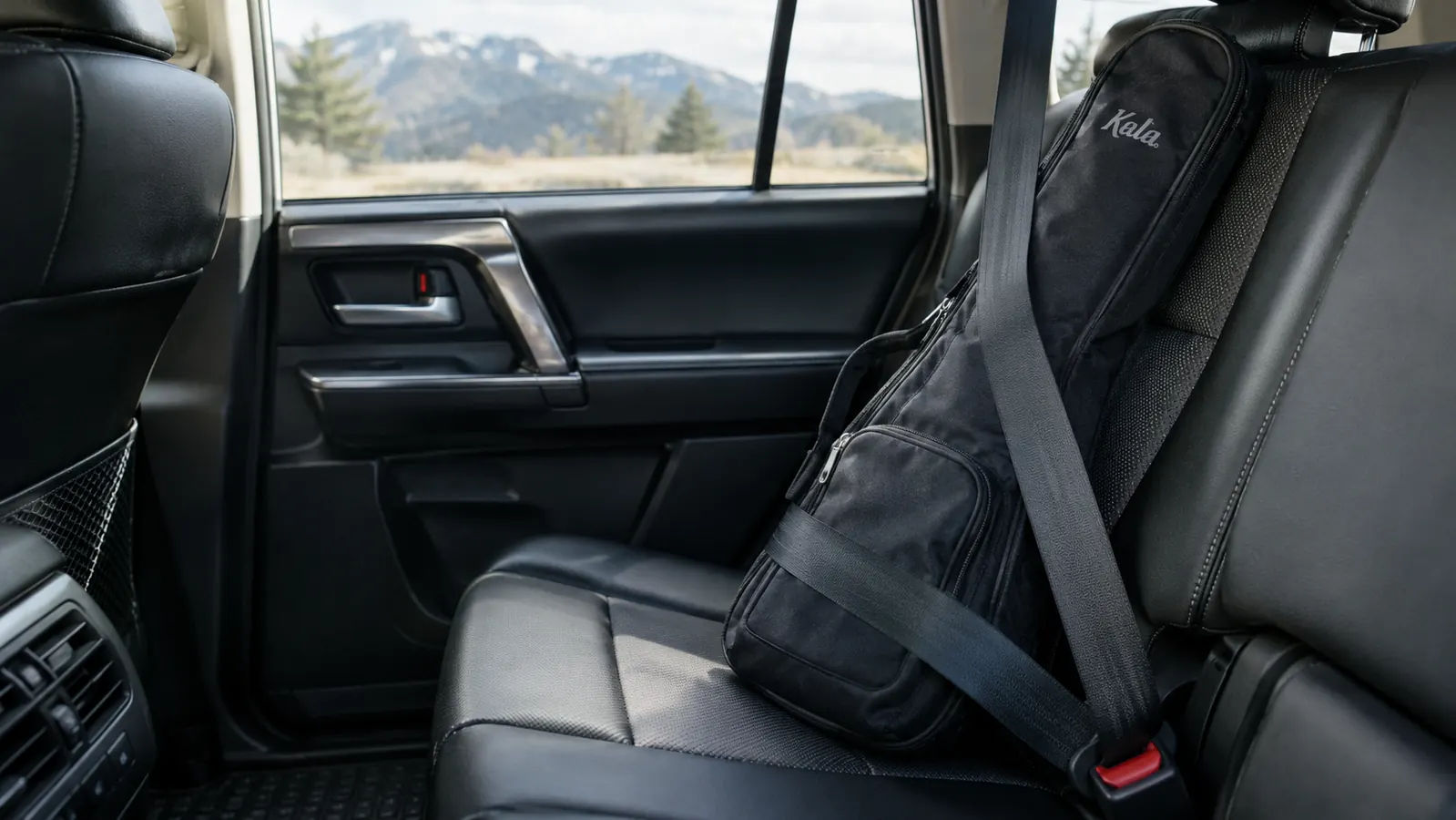
I have owned both, and for travel I strongly prefer a padded gig bag over a hard case. A hard case protects better against a direct crush, but it is heavier, bulkier, and harder to fit into the overhead bin or under a seat. The Donner kit I travel with includes a padded gig bag with a handle and a shoulder strap, and that bag has been through dozens of flights with me. It fits in my carry-on backpack, and it fits in the overhead bin without drama.
Inside the bag, I keep the ukulele neck-down with the headstock at the bottom. That way, if the bag gets set down hard, the weight lands on the body, not on the tuning pegs. I also slide a folded t-shirt between the neck and the side of the bag so the strings do not rattle against the zipper. It is a small thing, but it keeps the finish clean and the tuning pegs from taking little knocks.
One more packing note: never check the ukulele as baggage if you can avoid it. The cargo hold is cold, unpressurized, and full of things that can land on top of your instrument. I have watched too many musicians learn that lesson the hard way. A ukulele is small enough to be a personal item on most airlines, and that is where it belongs. On a flight to Honolulu last spring, I watched a gate agent wave a woman through with a ukulele in a soft case plus her carry-on, no questions asked. Keep it with you and you keep it safe.
Step 3: Give it thirty minutes to acclimate before you tune
The biggest tuning mistake I see is people tuning the moment they walk into the hotel room. The instrument is still cold from the cabin or the car, and the wood is still adjusting to the room temperature. You tune it perfectly, and twenty minutes later it has drifted again. Then you tune it again, and it drifts again. That is not a bad ukulele. That is a ukulele that has not caught up to the room yet.
My rule is simple: when I get to the room, I unzip the bag, let the ukulele sit out on the bed for thirty minutes, and go make tea or unpack. When I come back, the wood has settled, and the strings hold their tuning far better. On a beach trip, I do the same thing in the shade before I play. The instrument needs to be close to the temperature and humidity where it will actually be played.
This is also the moment to check the humidity if you are somewhere dry. A ukulele left in a desert hotel room can dry out fast. I keep a small travel humidifier in the gig bag pocket, and if the air feels dry, I put it in the soundhole while the instrument acclimates. It is a cheap habit that prevents the wood from shrinking and the tuning from becoming a moving target. On a trip to Palm Springs two winters ago, the room humidity read 18 percent on the first morning, and that little humidifier is the only reason the ukulele came home sounding like itself.
Step 4: Tune up to pitch, not down
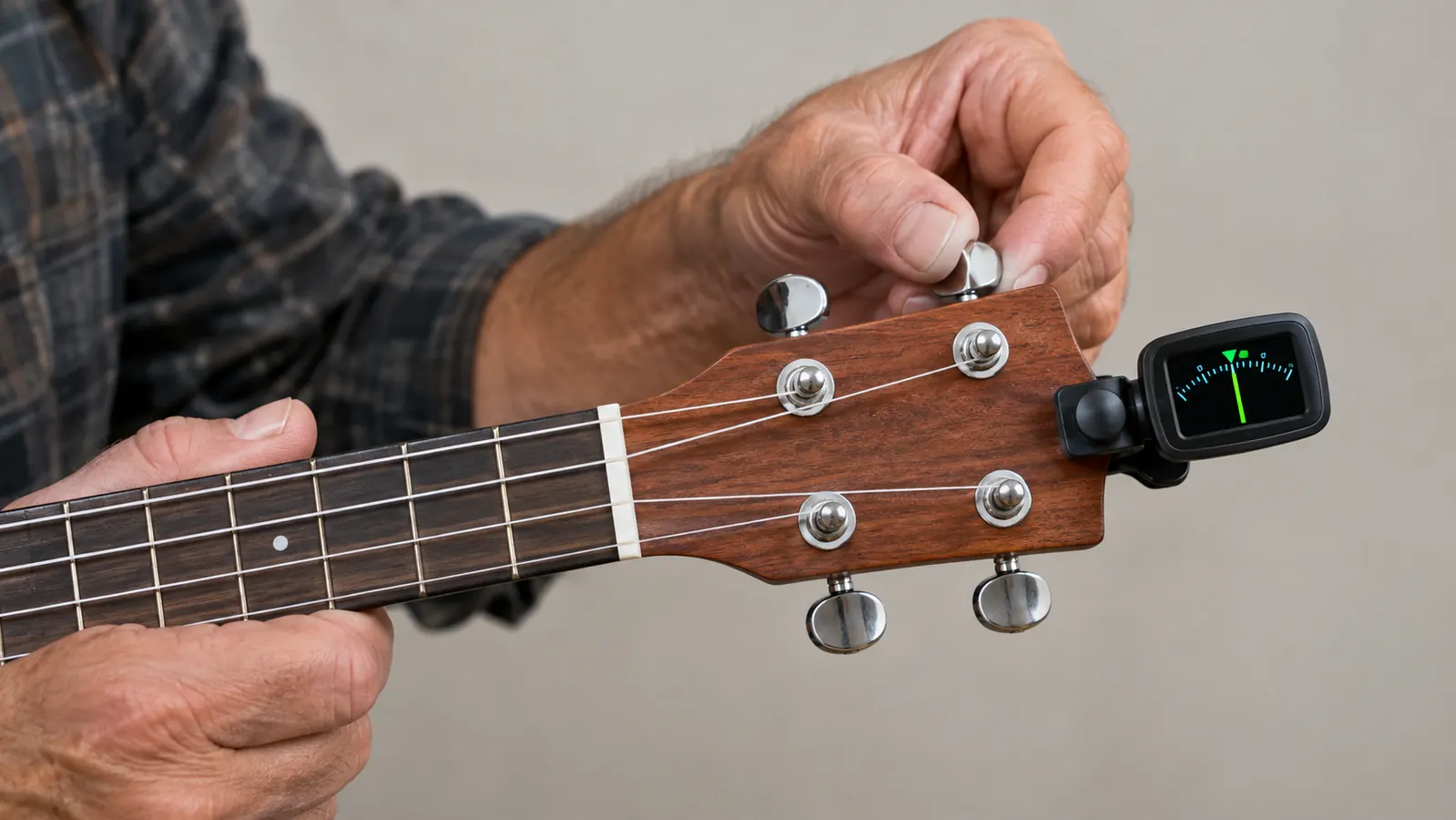
When you do tune, always tune up to the note, never down to it. If a string is sharp, loosen it a little past the note, then tighten it back up to pitch. That takes the slack out of the string and out of the tuning peg, so the note holds instead of settling a few cents flat a minute later. It is the same habit I used for years as a live-sound tech, and it applies to every stringed instrument I have ever touched.
I tune with a small clip-on tuner that lives in the gig bag pocket. It clips to the headstock, reads the vibration of the wood, and works even in a noisy hotel lobby or on a windy beach where a phone microphone would give up. The Donner ukulele has sealed tuning pegs, which means they do not slip the way cheap open-gear pegs do, but even sealed pegs need the tune-up-to-pitch habit to hold a note reliably.
Go string by string, and then go through them a second time. Tuning the G string can pull the C string slightly flat because the tension on the neck changes as you go. A second pass catches that. On a new ukulele, or one with fresh strings, you may need three passes and a few minutes of playing before the strings stretch and settle. That is normal, not a defect. The first time I put a new set of strings on this Donner, I had to tune it four times across an afternoon before the notes stopped sliding.
Step 5: Re-tune after the first few minutes of playing
Even after a careful tune, new strings and temperature-shocked strings will drift during the first few minutes of play. I tune, play for five minutes, and then tune again. The second tune is usually the last one I need for the whole session. If I am recording a quick video on the lanai, I always do this second pass before I hit record, because the first pass is never quite the final pass.
This is also the step where I check the intonation, not just the open strings. I play a chord up the neck, like a barre F or a C shape at the fifth fret, and listen to whether it sounds clean. If the open strings are in tune but the chords up the neck sound sour, the instrument may need a setup, and that is a conversation for a local shop, not something to fix on the road.
On a long trip, I repeat the whole routine each time the instrument moves through a big temperature change. Plane to hotel, hotel to beach, beach to rental car. Each move is a new acclimation. The routine takes about ten minutes total, and it has made the difference between a trip where the ukulele is a joy and a trip where it is a frustration. On a two-week stay on Oahu last year, I did the full routine four times, and by the end of the trip the ukulele was holding tune for days at a stretch.
What Else Helps
A few extras have earned permanent space in my gig bag. A spare set of strings, because a broken string on the road is a ruined session if you are not prepared. A small clip-on tuner, because phone tuners struggle in noisy environments. A travel humidifier for dry climates. And a soft microfiber cloth, because hotel air and beach air both find ways to leave a film on the strings. None of these cost much, and all of them have saved a moment at some point.
The other thing that helps is choosing the right instrument in the first place. A ukulele with sealed tuning pegs, a solid build, and a padded bag is simply easier to keep in tune on the road than a bargain instrument with open pegs and a thin gig bag. That is why I travel with the Donner concert ukulele. It is not the most expensive instrument I own, but it is the one I trust to survive a flight and still sound like music when I land.
The biggest tuning mistake I see is people tuning the moment they walk into the hotel room. The wood is still catching up to the room, and no tuner in the world fixes that.
Pack a ukulele that is ready for the road
The Donner concert ukulele I travel with has sealed tuning pegs, a padded gig bag, and a sound that makes the whole routine worth it. Check today's price on Amazon and see if it fits your carry-on.
Amazon Check Today's Price on Amazon →