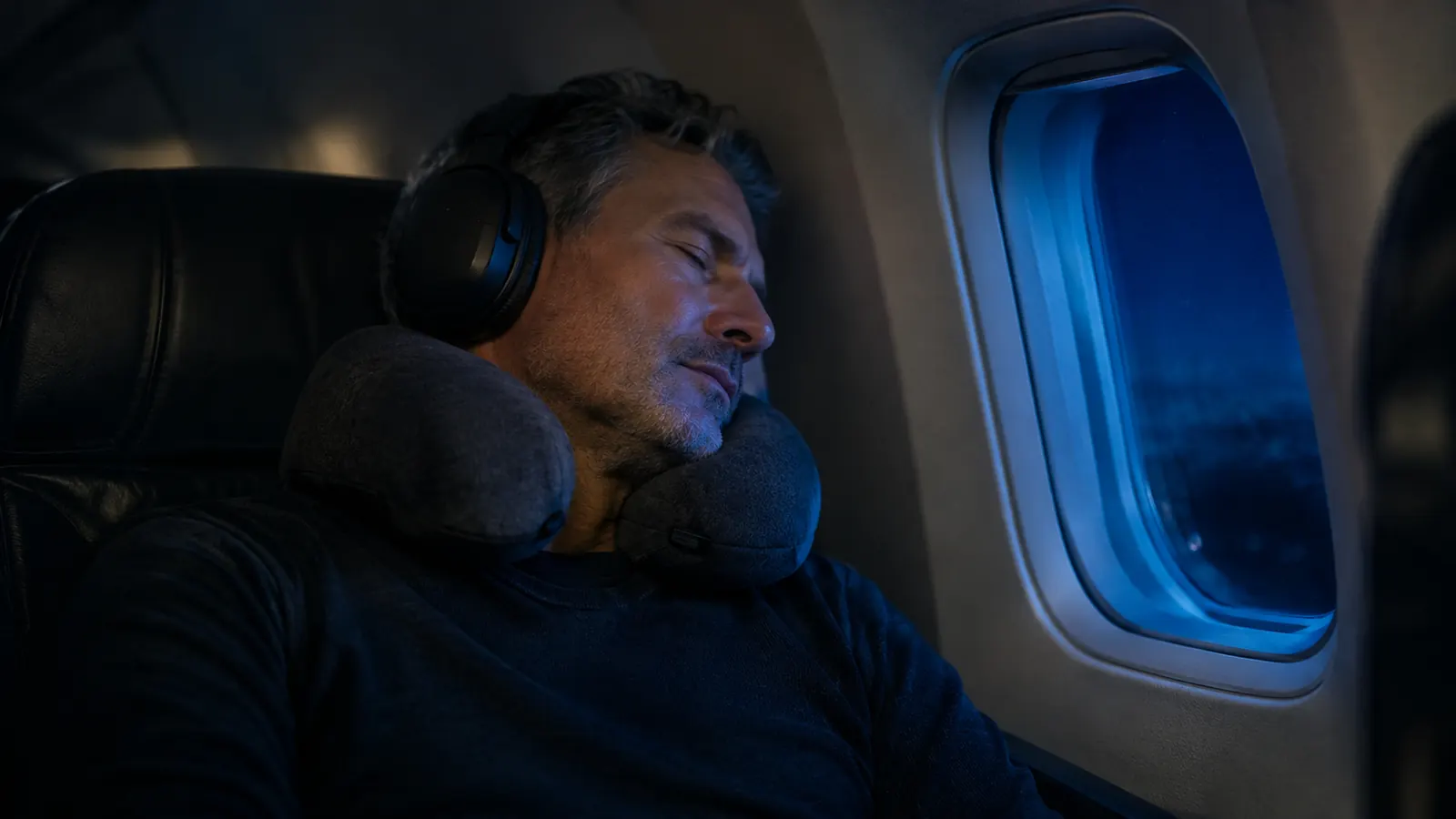
I spent thirty years in live sound, which means I spent thirty years not sleeping on buses, in van seats, and on loading docks. When I retired and started flying to Oahu a few times a year to see family, I figured the sleep problem would follow me onto the plane. It did, until I stopped treating the flight like a nap and started treating it like a small, repeatable system. The center of that system is a pair of Bose QuietComfort headphones, the over-ear wireless model, and the routine around them is what I want to walk you through.
This is not a review of the headphones, though I will say plenty about them. This is the exact order of operations I use, from the moment I book the seat to the moment I wake up somewhere over the Pacific. I have tested it on red-eyes, on early morning departures, and on the long daytime flight home when I am too tired to read and too wired to sleep. The Bose QuietComfort headphones are the piece that makes the rest of it work, because they remove the two things that always kept me awake: the drone of the engines and the sound of a hundred other people trying to be comfortable.
The headphones that finally let me sleep on a plane
Bose QuietComfort headphones cancel the low rumble of the cabin and sit light enough that you forget they are there. I have used them on every flight since I bought them, and they are the first pair I have owned that I can wear for a full red-eye without my ears aching.
Amazon Check Today's Price on Amazon →Step 1: Pick the seat before you pick the playlist
The headphones do the heavy lifting, but they cannot fix a bad seat. I have learned to book a window seat on the left side of the plane whenever I can. The left side matters less than the window itself, but the window gives you a wall to lean against, which is the difference between sleeping for two hours and sleeping for six. I also try to sit a few rows ahead of the wing, where the engine noise is a little less direct. The Bose QuietComfort headphones cancel most of that noise anyway, but every bit of head start helps.
If you can pick a seat with no one next to you, do it. I have had good luck on less full flights by choosing a window seat near the back and hoping the middle stays empty. That is not a strategy you can count on, but it costs nothing to try. The real point is to give yourself a surface to lean on and a wall to rest against. A neck pillow helps, and I will get to that, but the seat is the foundation.
One more thing: I avoid the last row and the row right in front of the lavatories. The door noise and the foot traffic are exactly the kind of intermittent sounds that wake you up. The Bose QuietComfort headphones handle steady noise beautifully, but a slamming lavatory door is a transient sound, and no noise cancelling pair fully erases those. Last February, on a flight from San Luis Obispo to Honolulu, I sat three rows from the galley and woke every time someone pushed the cart through. Give yourself a fighting chance by sitting somewhere quiet to begin with.
Step 2: Charge everything the night before
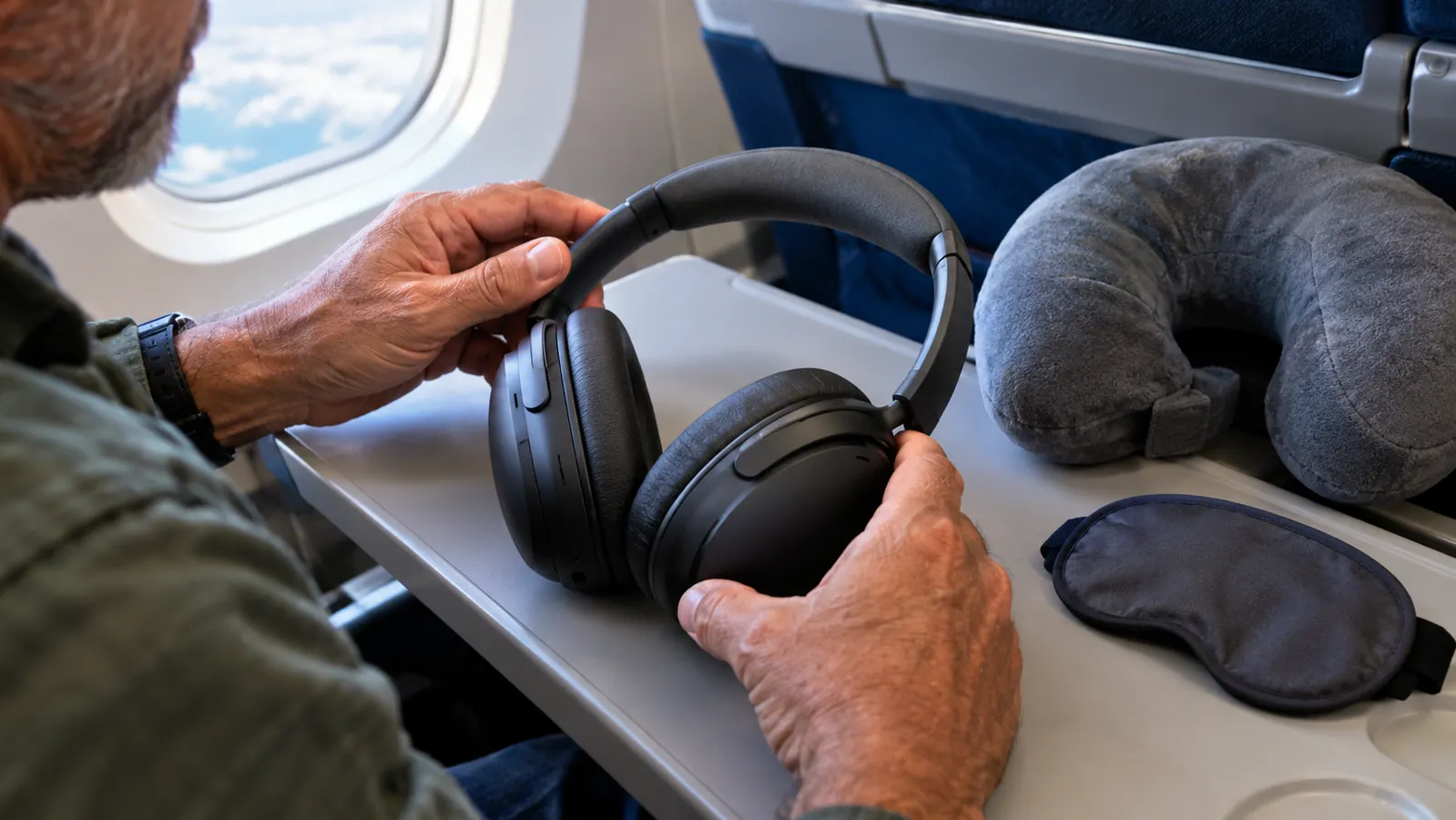
The Bose QuietComfort headphones have excellent battery life, but I never board a plane with less than a full charge. I charge them the night before, along with my phone, and I pack the charging cable in the front pocket of my carry-on backpack. The headphones use a USB-C cable, which is the same cable my phone uses, so I only need to carry one. That is the kind of small detail that matters when you are packing everything into a single carry-on.
I also turn the headphones off before I put them in my bag. It sounds obvious, but I have pulled them out at the gate more than once to find the battery drained because they paired with my phone in my pocket and sat there playing nothing. One time, I got all the way to the boarding area before I noticed the low battery light, and I spent the next hour hunting for a seat near an outlet instead of relaxing at the gate. A full charge on the Bose QuietComfort headphones lasts me a full flight plus the taxi and the drive to Lani's family's house, so I have never needed to charge them on a plane. Still, I carry the cable, because the one time you do not have it is the one time you need it.
If you are the kind of person who forgets to charge things, set a reminder the morning of the flight. The headphones charge quickly, so even twenty minutes at the gate can top them up enough for a short hop. For a long flight, though, start full. It removes one more thing to think about.
Step 3: Set the noise cancelling before you take off
The Bose QuietComfort headphones have a few different noise cancelling modes, and I have learned to set mine before the plane starts moving. I use the highest noise cancelling setting for the climb, because that is when the engines are loudest and the cabin is busiest. On my last red-eye, we pushed back at 10:45 PM and the engines roared for a good ninety seconds before we settled into the taxi. That is exactly the stretch when I want the highest setting, so I have it ready before the seatbelt sign comes on. Once we level off, I sometimes drop to a lower setting so I can still hear the flight attendants if they come by with drinks. The point is to make the choice yourself instead of letting the cabin make it for you.
I also turn off the feature that pauses your music when you take the headphones off. On a plane, you are going to shift around, and the last thing you want is for your music to stop every time you adjust the headband. The Bose app lets you turn that off in about ten seconds. I do it at the gate, before I board, so the headphones behave exactly the way I want them to for the next six hours.
If you are not playing music, you can still use the noise cancelling on its own. I do this a lot. I put on a podcast or an audiobook for the first hour, then switch to silence for the rest of the flight. The Bose QuietComfort headphones do not need to be playing anything to cancel noise, which is the feature I use more than any other. On one daytime flight home from Oahu, I watched the little battery meter barely move over three hours of silence, and that is when I understood how much headroom these have. Silence, on a plane, is the luxury.
Step 4: Use the pillow trick so the headband does not dig in
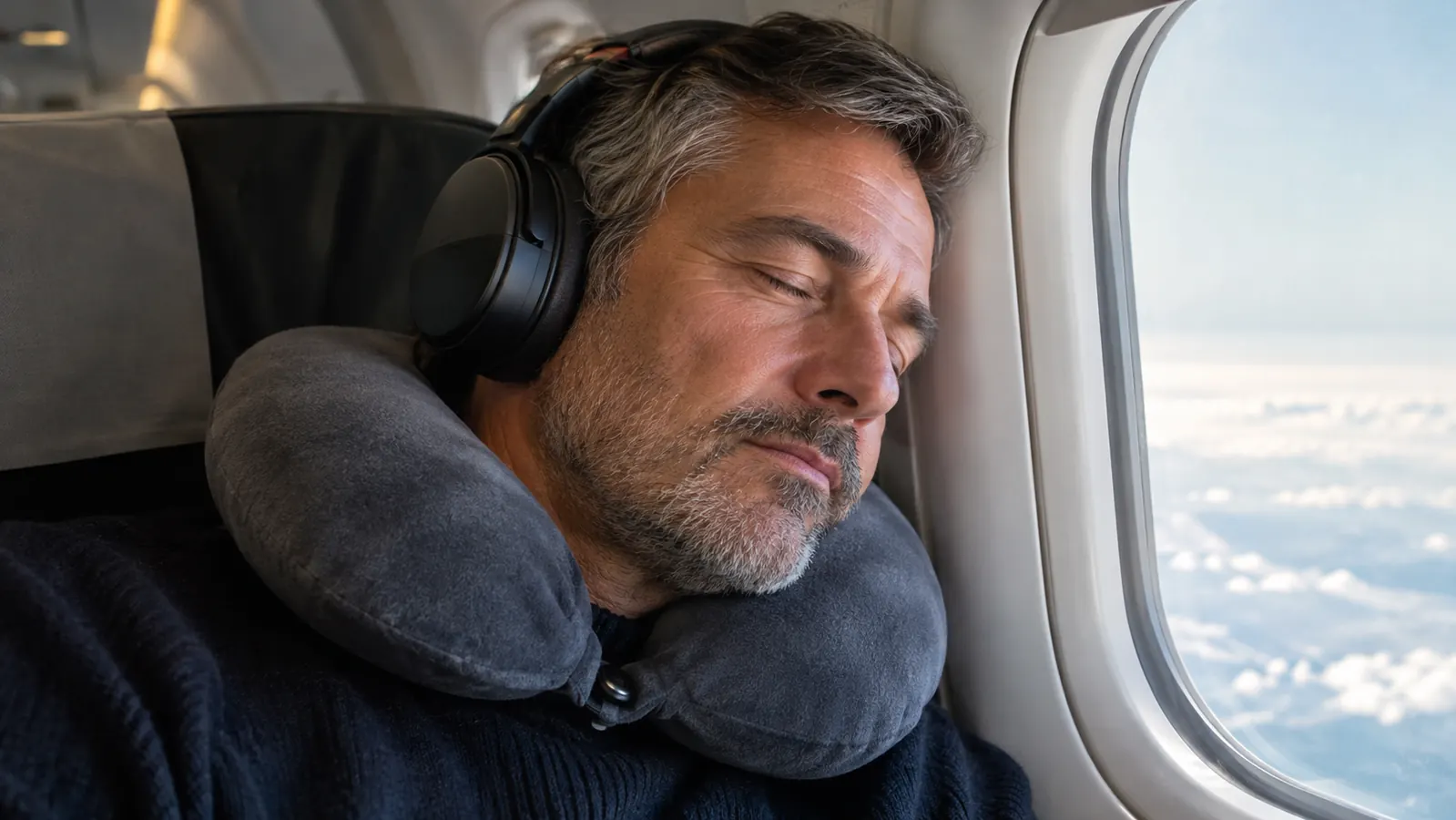
Here is the trick that changed everything for me. I wear a U-shaped neck pillow, but I wear it backwards, with the thicker part under my chin instead of behind my neck. Then I put the headphones on over it. The pillow lifts my head slightly, the headband of the Bose QuietComfort headphones rests on the pillow instead of on the top of my head, and the earcups sit exactly where they should. I can lean against the window without the headband pressing into my skull.
It took me two flights to figure this out. The first time I tried to sleep with the headphones and a normal pillow, the headband pushed the pillow forward and I woke up with a sore neck. The backwards pillow trick fixes that because the pillow and the headphones work together instead of fighting each other. The Bose QuietComfort headphones are light enough that this works well, which is not something I can say for every pair I have tried.
If you do not use a neck pillow, you can get most of the same benefit by leaning the top of your head against the window and letting the headband sit against the window instead of your scalp. That works in a pinch, but the pillow version is better. I have slept six hours on a red-eye with this setup, and I woke up with my ears comfortable and my neck only slightly stiff, which is a win by airplane standards. The seatbelt sign never came on, the couple next to me slept through the whole thing, and the landing was smooth enough that the captain did not even need to announce it.
Step 5: Build a sleep playlist that does not wake you up
The last piece is the audio itself. I have a playlist I only use on planes, and it is built for sleeping, not for listening. It is mostly instrumental music, some ambient stuff, and a few audiobook chapters I have already heard. The rule is simple: nothing with sudden changes in volume, nothing with a lot of talking, and nothing I will feel compelled to pay attention to. The Bose QuietComfort headphones make even a quiet playlist sound good, which matters more than you would think when you are trying to drift off.
I set the volume low, low enough that I can barely hear the music over the silence the headphones create. The point is not to listen. The point is to give my brain something steady to focus on instead of the tiny sounds that leak through. I also set a sleep timer on my phone so the audio stops after an hour. That way I do not wake up at 3 AM to a podcast about the history of the electric guitar. And I have learned to test the sleep timer before I close my eyes, because the one time I skipped it, I woke up at 2:40 AM to a voice talking about tube amplifiers.
If you prefer silence, skip the playlist entirely. The noise cancelling on the Bose QuietComfort headphones is strong enough that the cabin becomes a low, distant hum, and for a lot of people that is all they need. I go back and forth. Some flights I want the music, some flights I want the silence. The headphones handle both, which is why they are the pair I pack every time.
What Else Helps
I have one more paragraph in me about the things that are not the headphones. I wear a sleep mask, because the cabin lights come on at the worst moments. I bring a thin hoodie even on warm routes, because the air conditioning on planes is aggressive and a cold neck will wake you up faster than any engine noise. I drink water before the flight and skip the coffee, and I set my watch to the destination time as soon as I sit down so my brain starts adjusting. Last spring, on an early flight to see family in Honolulu, I forgot the mask and the overhead light above me stayed on for the whole crossing. I still slept, but it took twice as long to get there. None of these matter as much as the headphones, but together they turn a red-eye from something I dread into something I can actually use.
I have slept six hours on a red-eye with the backwards pillow trick and the Bose QuietComfort headphones, and I woke up with my ears comfortable and my neck only slightly stiff, which is a win by airplane standards.
Pack the pair that makes the red-eye feel short
The Bose QuietComfort headphones are the one piece of gear I will not fly without. They cancel the cabin, they last the whole flight, and they are comfortable enough to wear from boarding to landing. If you fly more than a couple of times a year, they pay for themselves in sleep.
Amazon Check Today's Price on Amazon →