

If you are trying to choose between the Zoom H1essential and the Zoom H4essential, you are probably standing in the same aisle I stood in about a year ago. I am Wes, a retired live-sound tech, and I pack one carry-on backpack for every trip I take, whether that is a flight to Oahu to see family or a weekend drive up the coast in my 2016 Toyota 4Runner. I wanted a pocket recorder that could capture a beach sunset, a hotel-room songwriting session, and the occasional interview without making me think about gear. I bought both Zoom recorders, used them for a year, and here is the short answer.
The Zoom H1essential is the one I reach for most days. It is smaller, simpler, and its battery life is genuinely ridiculous. The Zoom H4essential is the one I grab when I know I will need XLR inputs, or when I want the safety of recording on four tracks at once. If you mostly record yourself, your surroundings, or an occasional conversation, the H1essential is probably enough. If you are a musician who wants to plug in real microphones or record a band live, the H4essential earns its extra size and cost.
| Zoom H1essential | Zoom H4essential | |
|---|---|---|
| Size and weight | Fits in a shirt pocket, about 2.5 ounces | Bulkier, about 8 ounces, still carry-on friendly |
| Battery life | Roughly 18 hours on two AAs | Roughly 10 hours on two AAs |
| Built-in mics | Good stereo pair, fixed position | Adjustable X/Y mics that rotate for wider or narrower pickup |
| XLR inputs | None | Two combo XLR/quarter-inch inputs with phantom power |
| Recording tracks | Up to 2 tracks | Up to 4 tracks |
| Ease of use | Three buttons and a screen, hard to mess up | More menus, more options, steeper learning curve |
| Best for | Travelers, podcasters, songwriters capturing ideas | Musicians who need XLR mics or multi-track recording |
Where the Zoom H1essential Wins
The Zoom H1essential wins the moment I pick it up. It is the size of a small TV remote and light enough that I forget it is in my jacket pocket. On a flight to Honolulu last November, I recorded the cabin ambience, the flight attendant's welcome, and a window-seat conversation with my wife Lani without ever taking it out of my pocket. The H4essential would have done the same job, but I would have felt it the whole flight and I would have needed to find room for it in my carry-on. I measured both on my kitchen scale before that trip: the H1essential came in at about 2.5 ounces with batteries, and the H4essential at about 8 ounces. That six-ounce difference does not sound like much until you are already carrying a backpack, a camera, and a jacket through security.
Battery life is where the H1essential really separates itself. I have taken it on a three-day beach camping trip near Pismo Beach, recorded maybe two hours a day, and never changed the batteries. The H4essential, with its bigger screen and more processing, drains AAs noticeably faster. For a traveler who does not want to carry a spare battery pack, that difference matters. I keep a set of lithium AAs in the H1essential and a second set in my backpack, and I have never needed the second set on a trip. The H4essential, by contrast, has made me dig for spares more than once, including one evening at a hotel in Santa Cruz when I wanted to capture a song idea and the screen was already blinking low.
The H1essential also has a simpler menu. I handed it to Lani at a family gathering and she figured out how to record in about ten seconds. The H4essential would have required a quick lesson. There is something to be said for a recorder that does not ask you to navigate a menu tree when the moment you wanted to capture is happening right now. On a beach at sunset, with the light going and the waves doing exactly what I wanted to remember, I do not want to be scrolling. I want to press one button. The H1essential does that. The H4essential can do it too, but only after you have set it up the way you want it, and that setup is the part that takes the learning curve.
The pocket recorder I pack every single trip
The Zoom H1essential is the recorder I grab when I want to capture a moment without thinking about gear. It is small, simple, and the battery lasts longer than any trip I have taken.
Amazon Check Today's Price on Amazon →Size is where the Zoom H1essential pulls far ahead for a traveler. It is small enough for a jacket pocket and light enough that I forget it is in my carry-on backpack. The H4essential is noticeably bigger and heavier, closer to the size of a TV remote with a thick head. On a trip where everything has to fit in one bag, that matters every day.
The H1essential is also simpler. It has fewer buttons and fewer menus, so I spend less time setting it up and more time recording. When a song starts on the lanai with no warning, I can press one button and catch it. With the H4essential there are more choices to make, which is great in a studio but slower when the moment is happening right now.
Where the Zoom H4essential Wins
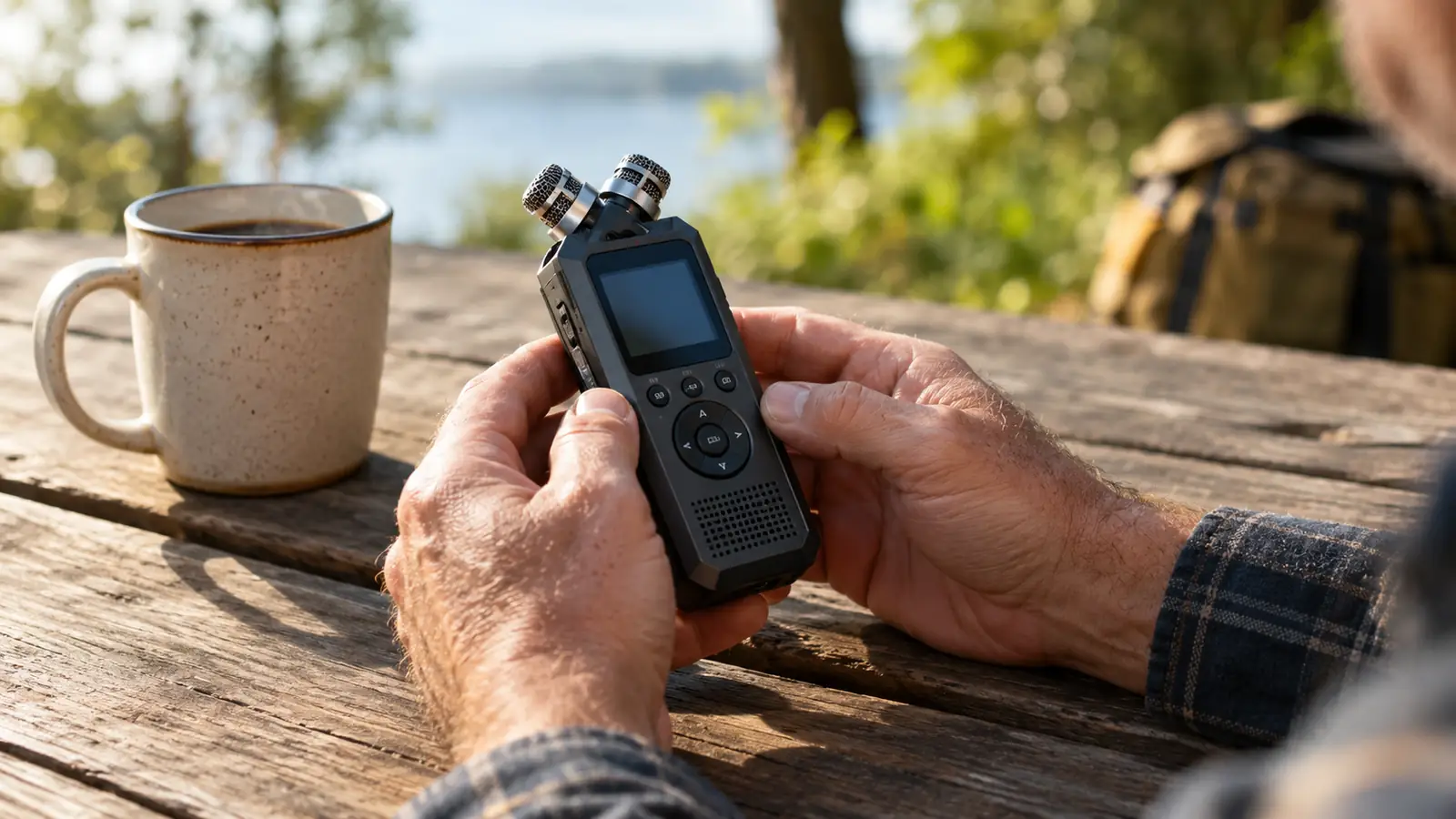
The Zoom H4essential wins when the recording gets serious. Its built-in mics rotate, so I can point them at a wide room or narrow them onto a single voice. That adjustability is something the H1essential simply does not offer. At a family reunion on Oahu in March, I set the H4essential on a picnic table with the mics spread wide and captured the whole conversation clearly. The H1essential would have sounded fine, but it would have picked up more of the table and less of the people at the ends. I tested that exact scenario the next morning, recording the same group with both recorders side by side, and the difference was obvious when I listened back on headphones. The H4essential kept the voices at the far ends intelligible. The H1essential let them blur into the general noise of plates and laughter.
The bigger win is the XLR inputs. If I want to plug in a proper microphone, the H4essential is the only one of the two that can do it. It also provides phantom power, which means I can use condenser mics. For a weekend musician who sometimes records a friend's acoustic guitar with a real mic, that is the difference between a toy and a tool. Last spring, a friend who plays classical guitar came through San Luis Obispo and we spent an afternoon in my living room. I ran a pair of small condenser mics into the H4essential, set the mics in a wide X/Y pattern, and recorded him for about forty minutes. The result was good enough that he asked for a copy to put on his phone. The H1essential, sitting on the coffee table, captured a decent room recording, but it could not match the detail and separation the external mics gave us.
The H4essential also records four tracks at once, which is overkill for most of what I do, but it is there when I need it. I have used it exactly twice in a year: once for a friend's podcast where we each had our own mic, and once when I recorded a small acoustic duo at a house concert and wanted a safety track in case one of the mics clipped. Both times, having the extra tracks meant I did not have to stop and redo anything. That is the kind of insurance you do not think about until you need it, and when you need it, the H1essential simply cannot help.
The H1essential is the recorder I reach for. The H4essential is the recorder I reach for when the mics matter.
The biggest advantage of the H4essential is its inputs. It has combination jacks that accept professional XLR microphones and instrument cables, so you can plug in a vocal mic or a guitar directly and record them alongside the built-in microphones. The H1essential only has a small 3.5mm input, which limits what you can connect.
It can also record several tracks at once, so a small group can be captured with separate control over each part later. For podcasts, interviews with two microphones, or recording a band properly, that is a real step up.
The H4essential also feels more solid in the hand, with a sturdier build and a guard around its microphones. If your recorder will live in a gig bag with cables and stands, that extra toughness is a plus. For a traveler mostly capturing songs and sounds, though, those strengths come at the cost of the size and simplicity that make the H1essential so easy to bring along.
Battery choice also differs. The Zoom H1essential runs on two AAA batteries, while the H4essential uses AA batteries. Both are easy to find anywhere, but the AA cells in the H4essential give it longer recording time between swaps, which matters if you record a whole evening without a break.
Both share the same 32-bit float recording, so neither one needs a careful level setting before you press record. That means the sound quality gap between them is smaller than the size gap suggests: for a song on a lanai or waves on a beach, I struggle to hear a difference on playback.
Price is also part of the picture. The H1essential costs noticeably less, so for a traveler who mostly wants to capture songs and places, the savings can go toward a windscreen, a tripod and a good memory card, which improve recordings more than the extra inputs would.
Both also work as USB microphones for a computer, which I have used for video calls from hotel rooms. Neither needed special software on my laptop, so either one doubles as a better microphone than the one built into the computer.
Who Should Buy Which
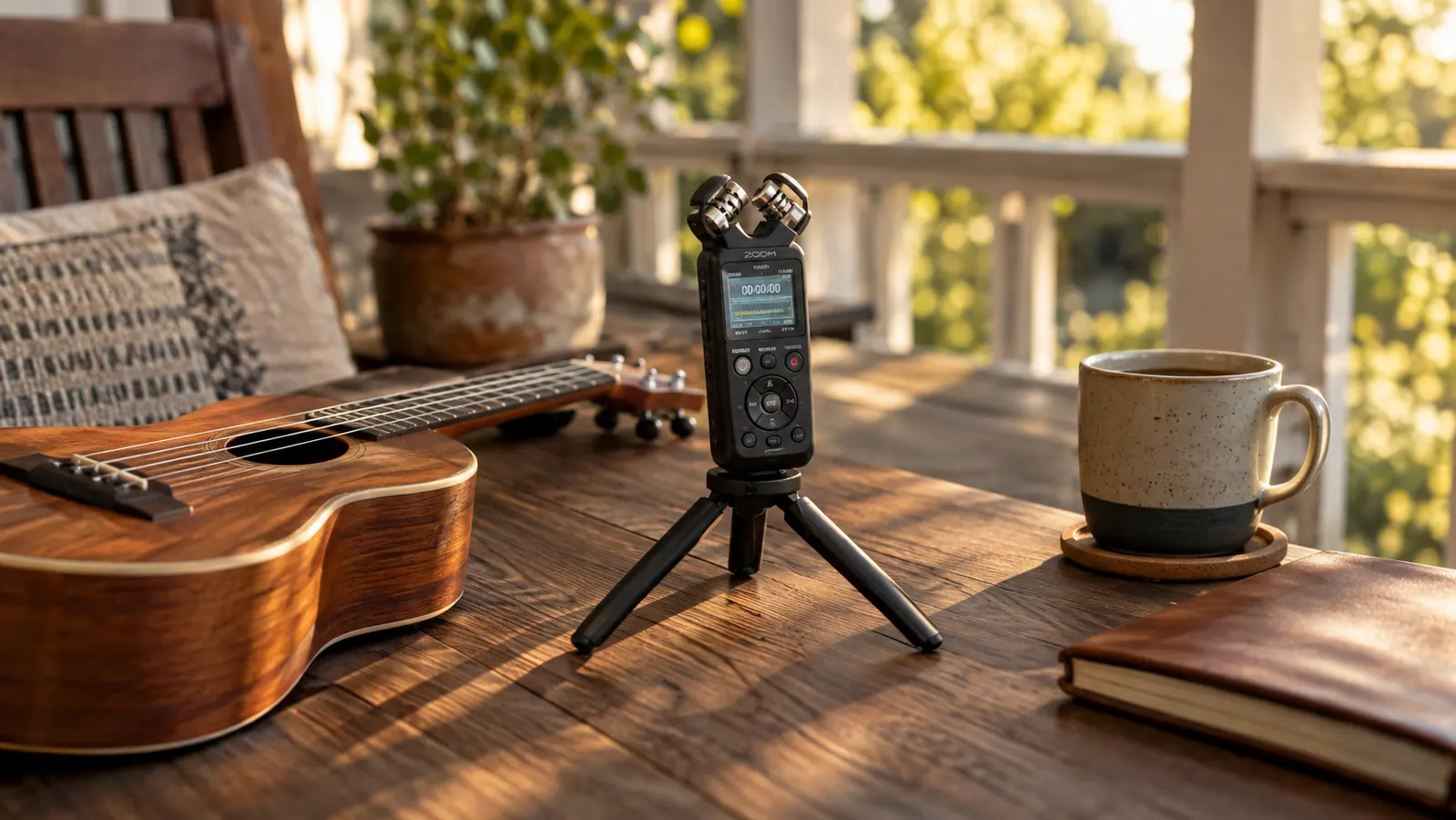
Buy the Zoom H1essential if you are a traveler, a podcaster, a songwriter, or anyone who wants to capture sound without carrying a kit. It is the recorder I pack for a beach sunset, a hotel-room idea, or a family dinner. It is also the one I hand to someone who has never used a recorder before. The H4essential is the better choice if you are a musician who wants to plug in real microphones, or if you regularly record bands, interviews with multiple people, or anything where four tracks give you room to breathe.
I own both. I use the H1essential about four times as often. But when I pack for a session where I know I will want a real mic, I take the H4essential and I do not miss the smaller recorder at all. That is the honest answer: neither is the wrong choice, they are just different tools for different days. If I had to pick one for a single carry-on bag and a year of travel, it would be the H1essential. If I had to pick one for a recording session, it would be the H4essential. Most people reading this are closer to the first situation than the second, and that is exactly why the H1essential is the one I recommend to friends who ask.
Start with the one that fits in your pocket
If you are still deciding, the Zoom H1essential is the safer first recorder. It is cheaper, lighter, and it will be in your bag when you need it. The H4essential can wait until you know you need XLR inputs.
Amazon Check Today's Price on Amazon →